Cab Driver: So what are your plans this weekend?
Me: Dunno. Go hiking?
Cab Driver: No, I mean for the game.
Me: What game?
Cab Driver: Superbowl?!
Me: Oh wow. Who’s playing?
Cab Driver: Where do you live?
Me: San Francisco
Cab Driver: No way…no way! What are you living in a cave?
Me: (dawns on me) The Niners! The Niners are in the Superbowl?
Me: Are they playing here in San Francisco?
(Cab driver looks like he’s going to cry.)
Cab Driver: No. NO! They are playing in New Orleans!
Me: Are they playing…the Saints?
(I was particularly proud I came up with this team name.
Cab driver almost drives off the road.)
Cab Driver: The RAVENS.
Me: Where are they from?
Cab Driver: Baltimore
Me: I thought that team was the Orioles.
Cab Driver: AAAAARRGH! Forget it!
(Long silence ensues.)
Me: Yeah, I think I’m going hiking.
Category: Uncategorized
Dance, animation, Ron Popeil
- All that ukulele playing finally paid off when I went to the Ukulele Rebellion last weekend after my clay class at Sharon Arts Center. So good.
- I have some thinky blog posts coming, just haven’t had the time to write them down, they’re just in my head.
- At a YBCA event last night I learned about the work of Capacitor, a bay area dance-circus group, showing this crazy piece with four dancers in a kind of cage, but with the sides made of an amazing stretchy rubber, like if a net had a baby with a trampoline. It was quite something! Their underwater highlight reel is here, but not quite the amazingness of the stretchy cage piece.
- At the same event, I learned about Kote Ezawa’s work, another Bay Area artist who teaches at CCA, whose best known work is an animation of the verdict of the OJ Trial. Ezawa was born in Germany, came to San Francisco to attend the Art Institute, and decided to stay. I liked this: “At the Art Institute, I always asked the security guards for their opinions. Security guards in museums and art schools often have an incredible knowledge of, and affinity with, art because they spend so much time looking at it. The artist Robert Ryman is just one of many well-known artists who started out as a guard. The best person you can have a conversation about art with is ‘the passerby.’ I like when people happen upon art, in contrast to the dedicated art audience that is looking for art.”
- “It’s like, how much more black could this be? …and the answer is none. None more black.” — Nigel Tufnel, This is Spinal Tap
- I was astonished that no one at my office had heard of Ron Popeil. I was extolling his virtues as a product designer.
Ukulele, Tune-yards, Blake
Another week and another weekend wind their way down the road, never to be seen again! And here I am blogging again.
- Do you know about shit? was the question Jessica was asked by her son, in one of the funniest notes ever left on Findery. It’s so charming it made my week. A duet, with the daughter…just read it.
- The Daily Ukulele
has been my constant companion this week, which I ordered on Jill’s recommendation (as well as its sequel, the Leap Year edition). Thus far I’ve managed to master The Boogie Woogie Bugle Boy and Blue Bayou, which led to an afternoon of listening to Roy Orbison, as I’d forgotten the tune.
- I had a lot of Tune-yards playing on my headphones at work this week. Here is Bizness, though my favorite song is Gangsta. I like the Bizness video better. (I watched them both just now).
I would welcome some new music recommendations! I was proud of having found Tune-yards…I have no recollection of how. Pitchfork? But my colleagues at work aren’t music recommenders, and none of my social music apps have come up with anything good recently.
- Following on last week’s conversations about a commercial-free childhood I somehow came across a book called Living Outside the Box: TV-Free Families Share Their Secrets
, which I read, and which would probably have been informative and novel to someone who watches a lot of TV, but I never have, so most of the things these families were saying (“I have so much more time! I now play the guitar, exercise, talk to my family!” “We average 48 minutes of meaningful conversation per day!”) and so on, were not new to me. It didn’t talk about screen time in general — video games computers and social networking. Nonetheless, I enjoyed reading some parts of it, and learned that people take offense at people who are TV-less as they feel it is a judgment of them. I nodded at the part about how the people who are most adamant about the TV-less life turn out to be those, like me, who did not watch TV growing up, and know that not being familiar with Saturday Night Live won’t make you a pariah. If you’re interested in this book, I can send it to you. Email me your address! TV-watchers considering eliminating TV preferred.
- Kickstarter’s year in review is amazing. I missed a bunch of those awesome projects, but I participated in at least one! I am proud to be an investor (which is either bragging or Full Disclosure, you decide). I love Kickstarter!
- I am reading The Blue Poetry Book
, a collection of children’s poems, because I can’t bear the amateurish poetry included in my daughter’s homeschool curriculum. There is a lot of Blake in here, and some serious, sinister poetry. For example, a medieval English ballad, The Demon Lover, which I’d known only as a folk song The House Carpenter, on Harry Smith’s Anthology. Kids love this kind of thing! I got sick of reading all these Going Shopping With Mommy type books, and got The Highwayman and Orpheus
by Charles Mikolaycak, Aïda, Golemand other serious children’s books.
- Saturday Crafternoon, I finished my rug! And made a clay pot on Sunday, in a class with my sister.

Learning about the World
Back in the early days of this blog, after the weekend, I’d write about what I did the week before in an unordered list. This pressured me to do interesting things, which was a good thing, and reflect on them. Also a good thing. So this post is an effort to get back into the habit.
- One of the many wonderful things about homeschooling is that I am constantly learning alongside my daughter. She asks a lot of questions and my answer is often, “I don’t know, let’s find out.” But today we went hiking at the Redwood Regional Park in Oakland, after yesterday’s rainfall. The Pacific Northwest is a fungal wonderland, and the mushrooms were in full bloom, most of them having come up in the last day. I was able to impart a lot of my knowledge of mushrooms to my daughter, identifying Russulas, polypores, slime molds, and the ubiquitous “LBMs” or “little brown mushrooms” as David Arora calls them in his classic of mycology, “Mushrooms Demystified”. We are now making spore prints from all the mushrooms we found.
- I wrote a brief blog post on LinkedIn called Are you on the wrong road? Turn back!, based on some advice given me years ago by my friend Jim, which I’ve used countless times since. I now have almost as many followers on LinkedIn as I do on Twitter. And great feedback and conversations, which happen rarely, to my sadness, here on caterina.net, like they used to in the old days.
- After reading about the Al Ain Oasis by ECWC, I became curious about cultivating dates, and browsed about the web a bit, learning. And made a note of it on Findery (of course). An incredible number of dates are produced by each tree! They’re as big as banana bunches! I had no idea.
- I joined a meetup group called Bay Area Parents for a Commercial-Free Childhood which I had searched for as I was going to start a group like it myself. It’s becoming increasingly difficult to find kids to hang out with that don’t consume a lot of commercial culture. I met the group’s founder Jill and her daughter on Saturday. She tuned my ukulele and even tried to play “Five Foot Two” for me. And alerted me to yet another group that gets together at the Oakside Cafe, the Ukulele Rebellion. I’m looking forward to more art, nature and music. Awesome!
- Saturday Crafternoon happened, a bunch of friends came over, and we modeled polymer clay, embroidered, and I worked on another rug made of tshirts. I love Saturday Crafternoons.
[findery https://findery.com/sets/811749873820 width=”500″ height=”400″]
Our memories are what make us – Kathleen Dean Moore
Identity is what makes me who I am, as opposed to some other person. In the seventeenth century, English philosopher John Locke suggested a series of thought experiments that involved transplanting certain parts of the self, to find out what essentially defines us: Suppose that your next-door neighbor were in your body, and you were in hers. You suddenly had short blond hair, for example, and broad hips. Would you still be you? If so, then your body is not essential to your personal identity.
Now suppose that your characters were transposed. You took a lover and lied about it, or started going to church, neither of which is like you. Would you then be a different person? I don’t think so. You’d be the same person, acting in strange new ways.
But now suppose that your memories were transposed with your neighbor’s. You thought of your neighbor’s children as your own and remembered the day they were born and how that felt. They were asleep in maple beds that you remembered inheriting from your mother. At that point, I think, you would have become someone else.
So, to a certain extent, it’s your memories that make us who we are. For example, I am the person who remembers seeing a flock of white pelicans over Thompson Lake and the apple tree in the backyard of my house. And every time I notice something, every time something strikes me as important enough to store away in my memory, I add another piece to who I am. These memories and sense impressions of the landscape are the very substance of my self. In this way, I am – at the core of my being – made of the earth.
Founder Collective II
We are excited to announce Founder Collective II! We’ve closed a $70MM fund and will be pursuing the same seed-funding founder-focused strategy of our first fund. I’ve had an amazing time meeting dozens of entrepreneurs, and helping them realize their respective visions. So, super excited to keep doing it, while still working as an entrepreneur myself.
How to be Free: Proustian Memory and The Palest Ink
[An artist wrote me to ask if this essay was online; I had written it for the show Free at the New Museum, and it had been taken down. So I am reposting it here for posterity.}
…
The palest ink is better than the strongest memory.
— Chinese proverb
In 2001 the hard disk on my laptop crashed and everything on it was lost. I’d been using the computer for two, almost three years, and had all my work on it—email, which was stored locally; photos; fragments of poems; presentations; sketches; ideas; love letters; everything. I lamented the loss to my friends and got lectured on doing backups. I sent the disk out to be repaired, but word came back from the shop that there was nothing that could be done. Miserably I thought of all the precious memories I’d lost.
Days later, after the initial shock had passed, I had a sudden sense of liberation and relief. 1999-2000-2001—I was completely free of those three years— I had no archive.
Recently I tried to recover some old blog posts from 1998–2003, and found they were also gone. I went to the Internet Archive’s Way Back Machine, but it turns out at some point I’d blocked the Archive on my robots.txt. And I remembered the impulse that inspired the blocking: the ruthlessness of computers and how, if you set them up a certain way, the way that has become, today, the default— they never, ever forget.
Several years later, I started a website called Flickr with a team of people in Canada, a site for digital photographs, shared among a social network, with the photos defaulting to a public view. It incorporated tagging, groups, an API, posting photos on other sites, and other features that have now become standard in social media. It grew very rapidly, and as one of my friends told me, Flickr was a great place to be a photograph. A photograph could remember the name of the wine you liked at that restaurant, that brunch where your friend made the funny jokes, the slant of sun on a winter’s day, your lover’s face that morning in May. We’d improved ourselves by improving our recall, our memory.
One of the first users of Flickr was a guy who seemed to photograph every minute of every day. Untied shoelaces, spots on the pavement—nothing seemed too trivial to escape his documentation and attention. This is excessive, even pathological, I thought. But it was nothing like what was to come. The participatory media of Web 2.0—MySpace, YouTube, Flickr, Facebook, Twitter, and so on—made documentation, sharing, deliberate and passive documentation a daily activity for billions of internet denizens, including businesses, governments, and citizens.
“Free” is the museum show of our times, presaging the whole Wikileaks dustup, and it shows shifting power dynamics and a glimpse of the human in a world of flowing data. Pervading the show is this sense of how the “data”—the “facts,” if you will—tells us something, but fails to capture the human drama, the story, the suffering, the lived lives behind the information gathered and displayed.
Lisa Oppenheim gathers photographs that American soldiers stationed in Iraq have taken of Iraqi sunsets and posted on Flickr, prints them, and then holds them up, re-photographing against her own, local sunsets in an act of tribute and attempt at communal experience. The gulf yawning between her experience and theirs, the impossibility of connection, is emphasized. The sense is that their lives in a war zone cannot be known, and only a gesture is made to demonstrate fellow feeling.
Images of people caught on Google Maps “Street View” appear in Jon Rafman’s work, of which Rafman says:
The world captured by Google appears to be more truthful and more transparent because of the weight accorded to external reality, the perception of a neutral, unbiased recording, and even the vastness of the project.
We are bombarded by fragmentary impressions and overwhelmed with data, but we often see too much and register nothing.
Although the Google search engine may be seen as benevolent, Google Street Views present a universe observed by the detached gaze of an indifferent Being. Its cameras witness but do not act in history. For all Google cares, the world could be absent of moral dimension.
Joel Holmberg collects earnest, whimsical and profound questions on Yahoo! Answers, foregrounding their often earnest, whimsical, and profound responses. They are both mock-serious and mock-comic in attitude, showing, again, the gap the medium creates between the querent and the human truth. Martin Hendrick’s video of shockingly callous texts (LOL!!!I) in response to the footage of Saddam Hussein’s execution shows how people become things, how digital experiences are reduced to entertainment, and how meaning is leached out of the most significant or fraught events. It’s impossible not to see how the anonymity of online interactions dehumanizes us.
This effect is nowhere more tragic than in the real-life suicides of various teenagers living their lives online: Tyler Clementi, a freshman at Rutgers University, was having sex with another guy when his roommate and a female student broadcast their intimacies on the internet, resulting in Clementi throwing himself off a bridge and killing himself. Abraham Biggs, a young nineteen-year-old man from Florida, committed suicide live online, on the “lifecasting” site Justin.tv while viewers said “go ahead and do it, faggot.” And Megan Meier, a thirteen-year-old, hung herself after her rival’s mother created a fake MySpace identity “Josh Evans” to bully and humiliate her.
Can you withdraw? Can you escape? Is it possible to exist without being recorded by people’s devices, the unscrupulous roommates who would broadcast our most intimate moments, not to mention the ubiquitous closed-circuit cameras? Writer Evan Ratliff conducted an experiment for Wired magazine, in which he attempted to vanish for thirty days. His data trail was collated by various self-anointed online detectives (a $5,000 prize was offered to the person who could find Ratliff, say the word “fluke,” and take a photo of him) and he was eventually found. The sheer difficulty and inconvenience he underwent to attempt to evade detection was a lesson to us all. The project has launched an entire movement of efforts to disappear.
”Free” includes Jill Magid’s work Becoming Tarden (2010), a book-length profile of 18 Dutch secret service agents, created in collaboration with the agency. The final product did not meet the agency’s approval, and 40% of the text was censored — to protect the agents and the agency, to permit them secrecy, to allow their work to continue, as a secret service agency does, in private. Many arguments against the release of documents by Wikileaks covered the same territory: is some level of privacy required for diplomacy to take place? Not secrecy, mind you. Privacy. All of our parents had to do something in order for us to be conceived and born. It’s not a secret. But it likely happened in private. A necessary distinction.
Becoming Tarden is exhibited at the New Museum, copies of the book printed with the text blacked out, hiding the any information that might identify the secret service agents. Did their real selves escape behind those black boxes? You get the feeling it was never there to begin with. The book’s final quote is from Jerzy Kosinski’s Cockpit, where the character “Tarden” appears:
All that time and trouble, and still the record is a superficial one: I see only how I looked in the fraction of a second when the shutter was open. But there’s no trace of the thoughts and emotions that surrounded that moment. When I die and my memories die with me, all that will remain will be thousands of yellowing photographs and 35mm negatives in my filing cabinets.
The works of art in “Free” show the gap between the impassive data-gathering technology, human input, and the strange hybrid that is result of those interactions. As the human and data combine, as we appear in surveillance cameras, and leave behind traces on the internet, we’re in an alien netherworld, our selves and our humanity fugitive beyond the machine. There’s a reason we say IRL: our real life happens offline, unrecorded.
I often wonder if we should build some kind of forgetting into our systems and archives, so ways of being expand rather than contract. Drop.io, an online file sharing service, allowed you to choose the length of time before your data would be deleted. This seems not only sensible, but desirable. As Heidegger said, in Being and Time, “Forgetting is not nothing, nor is it just a failure to remember; it is rather a ‘positive’ ecstatic mode of one’s having been, a mode with a character of its own.” Proustian memory, not the palest ink, should be the ideal we are building into our technology; not what memory recalls, but what it evokes. The palest ink tells us what we’ve done or where we’ve been, but not who we are.
If we are not given the chance to forget, we are also not given the chance to recover our memories, to alter them with time, perspective, and wisdom. Forgetting, we can be ourselves beyond what the past has told us we are, we can evolve. That is the possibility we want from the future.
I remember a quote from the pre-digital, offline version of my high school yearbook, more than 20 years ago, which seems impossibly corny to me now, but so very true:
teach disappearing also me the keen
illimitable secret of begin
— e.e. cummings
Seam Allowance
I ran into my friend Rena Tom today, who is starting what I would call, from my techcentric viewpoint, a hackerspace for makers, down the street from the Findery office. It is called Makeshift Society, and they will be a workspace, community space, gallery space, and hold classes and events there. I’m excited about it.
Surfing the site from the members page, I came across Seam Allowance, by Kristine Vejar, and her post about the path she followed to create Seam Allowance — learning to sew when she was six, taught by her Grandmother and her Grandmother’s friends; growing up wearing clothes from big box retail store, and then traveling to and studying in India where the making of clothes was part of daily life. It is quite a beautiful statement, and worth reading in its entirety. She says:
I dream of people taking textiles as seriously as they do food; the process of making them, of who is making them, and the materials used to make them. For one moment, just think about how much you might spend on a dinner. In this area, if you are eating in a restaurant which sources ingredients locally, and has trained chefs, dinner per person can easily cost $50. Now think of the shirt you are wearing, and how much you paid for it, and where it was made. How many miles did the shirt have to travel to reach you? How many people laid hands on your shirt before it reached you?
To live her beliefs, Kristine is trying to make 25% of her clothing. Very inspiring!
I am designing a skirt
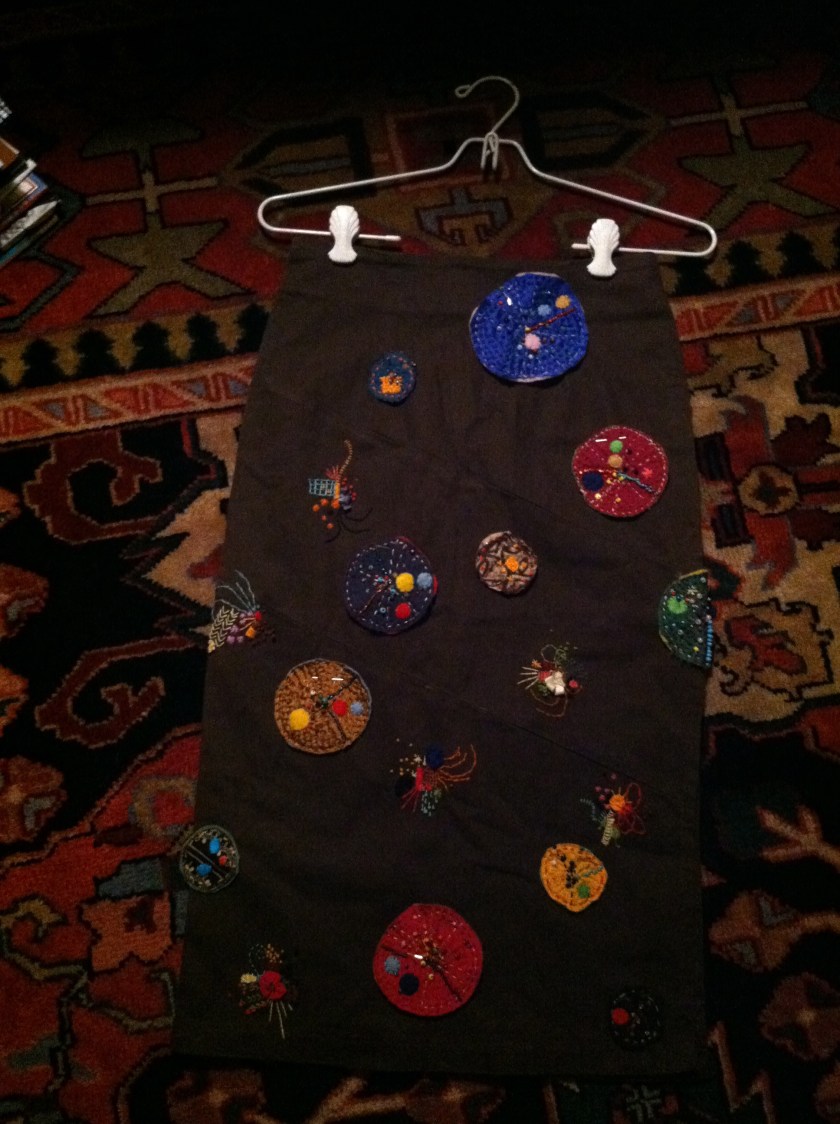
I had a lot of silk shirts from when I tried and failed to make a skirt years ago, and a bunch of beads from sculptures I used to do. It’s almost done.
I had a lot of silk shirts from when I tried and failed to make a skirt years ago, and a bunch of beads from sculptures I used to do. It’s almost done.
The Story Cabinet
In my house there is an old Chinese cabinet, full of little figurines on two shelves. They are for my daughter, to tell stories. We have told hours and hours or stories using these figures. There are all kinds of people, children and adults, and all kinds of animals — elephants, tigers, snakes. There are trees and cars and boats. There is an airplane. An angel, a devil, a vicious dog, a knight. They were mostly acquired at flea markets and yard sales.
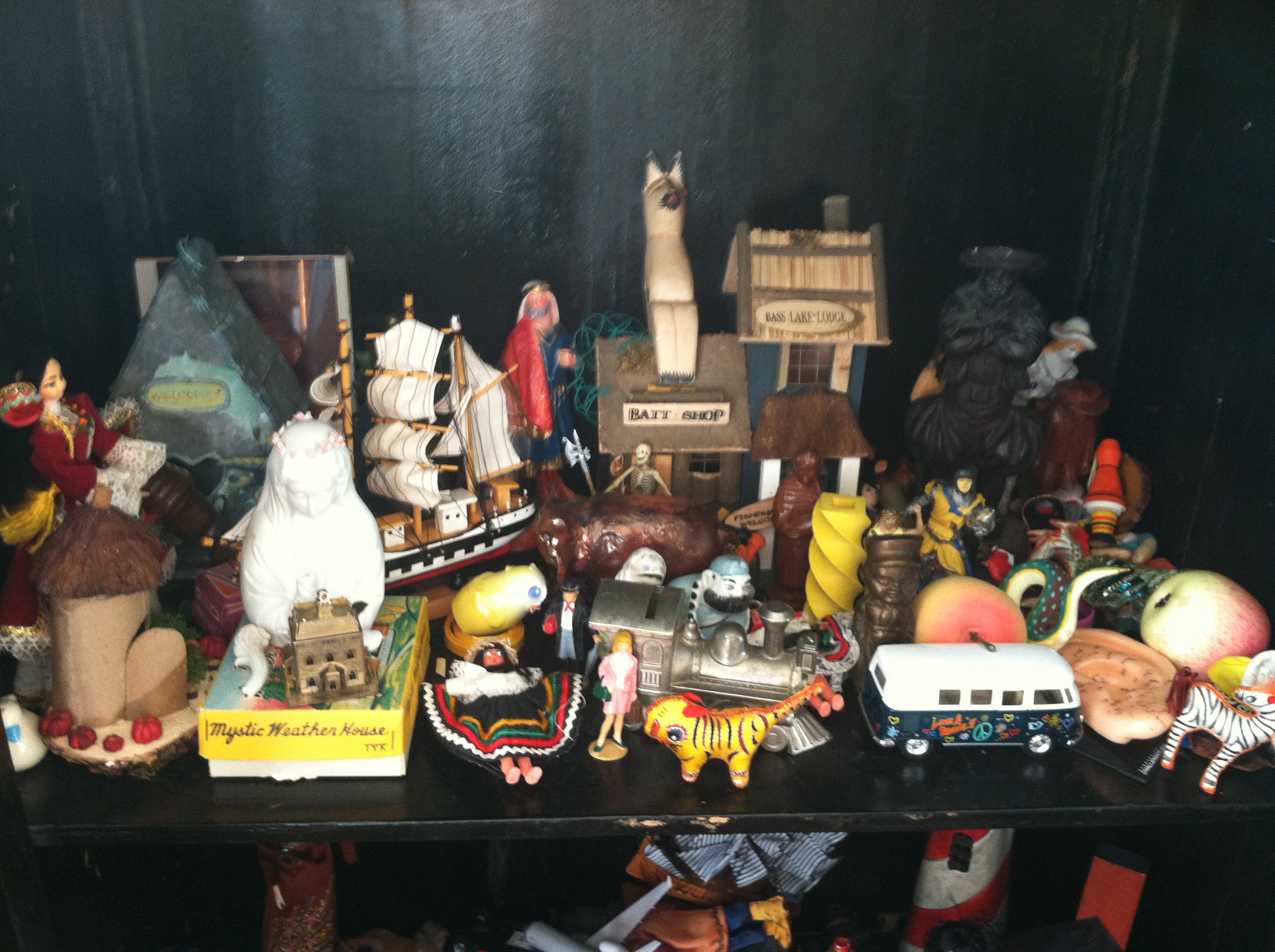
I am looking for more natural land features — mountains, lakes, volcanoes. Other house-like things, such as chairs and ladders and things. Dollhouse furniture is too expensive and too small, so I think I will have to make some of them.

 Caterina.net