Scouts, Water, Lorena Bobbit

boy-scouts-girl-cub-scouts-promo.jpg

Scouts. Girls are now formally eligible to form boy scout troops. Not only was the copy editor asleep at their desk, the author did not note the inherent sexism of this odd new eligibility. Why not call both Girl Scouts and Boy Scouts “Scouts”? And are there boys clamoring to form girl scout troops? That would show some progress. As it has often been said, equality will have a chance not when girls can be more like boys, but boys can be more like girls.

Water. The state of water in the world in less than 500 words. This will be a big issue in the future if the population continues to grow as projected, and this is a good summary of the regions the problems will arise, and who is getting in front of the issue.

Lorena Bobbit. Of course the real story was not what was emphasized on late night TV–the penis. The real story was about years of marital rape, domestic violence and male entitlement. Did you know John Wayne Bobbit became a porn star after his penis reattachment surgery and was convicted and served time for tying a woman up and repeatedly raping her? All those jokes at Lorena Gallo’s expense are hard to countenance–but an upcoming documentary may set the story straight.


Anxy, Hilma & Vassar

proxy.duckduckgo

  • I am a huge fan of the new magazine Anxy by Bobbie Johnson et al. which is a beautifully designed, thoughtful bi-annual magazine about our inner lives, our psychology and our behavior. Recent issues have centered on Boundaries, Workaholism and Anger. In the most recent issue, on the subject of Masculinity, I found some terrifying quotes from pre-teens, who, when asked the question, “What is Masculinity?” presented the most violent, aggressive and insensitive men as paragons of masculinity. Can we all watch The Mask You Live In again please? 
  • I’ve had many vicarious experiences, which are often better than original, immediate, actual, personal experiences. A wonderful example of this is in a short story–a very short story–by Lydia Davis, reproduced here in full:

Happiest Moment

If you ask her what is a favorite story she has written, she will hesitate for a long time and then sat it may be this story that she read in a book once: an English-language teacher in China asked his Chinese student to say what was the happiest moment in his life. The student hesitated for a long time. At last he smiled with embarrassment and said that his wife had once gone to Beijing and eaten duck there, and she often told him about it, and he would have to say the happiest moment of his life was her trip, and the eating of the duck. 

I recently had the experience of attending the Hilma af Klint exhibit at the Guggenheim vicariously, since all my friends have gone, and raved about it. Who says these things can’t be among your happiest moments?  I also feel as if I have seen Saturday Night Live through other people, never having seen it myself, as well as having read Thinking Fast and Slow and Sapiens by osmosis, surrounded, as I have been, with people who have in fact read it themselves. We can live through other people, much of the time, and experiencing the joy of other people as if it were your own is one way of guaranteeing your own happiness. 

  • Vassar, my alma mater, has a beautiful campus, full of trees and old buildings, exactly the way you imagine a college campus to look. I went back recently to give a keynote at the Sophomore Career Development event, and was happy to note that very few students were staring at their phones. 

More:

Have a look through the Vassar Quarterly to see what a great school Vassar is. I love small, liberal arts colleges, and my education there was exceptional. The cover of the most recent issue shows the campus in all its autumnal leaf-changing glory. And downtown Poughkeepsie is on track for a wonderful revival, having started some projects with the amazing non-profit design firm MASS Design Group

 This is a wonderful collection of very short stories by Lydia Davis, who also does beautiful translations from the French, such as Swann’s Way, the first book of In Search of Lost Time; a new translation of Madame Bovary, as well as translations from Maurice Blanchot, another of my favorites, such as The Gaze of Orpheus.


Another way I’ve vicariously experienced the Hilma af Klint exhibit is through this book, which I was given as a gift by another exhibit attendee. This, and her book of Notes and Methods, are gorgeous. 

The Social Media Transformation of César Sayoc: I disagree

In today’s New York Times, I find an article tracing the evolution of the Trump Supporter’s campaign to kill Democrats from his “normal” Facebook posts, to his “extremist” Twitter account. The article begins:

Until 2016, Cesar Altieri Sayoc Jr.’s life on social media looked unremarkable. On his Facebook page, he posted photos of decadent meals, gym workouts, scantily clad women and sports games — the stereotypical trappings of middle-age masculinity.

This may be common, but it is far from “unremarkable” as reporter Kevin Roose states.  I remarked many things about it. Then a quote from an expert in digital journalism:

“He went from posting pictures of women, real estate, dining and cars to posting pictures of ISIS, guns and people in jail,” said Jonathan Albright, the research director for Columbia University’s Tow Center for Digital Journalism. “It’s a remarkable change.”

From unremarkable to remarkable. However, here is what I remarked in the first incarnation of Mr. Sayoc’s online persona.  “Scantily clad women” denotes objectification; women as things, not people; decadent meals signal affluence and pleasure; real estate and cars are signs of prestige, money and power. All of these are signs of toxic masculinity, an idea of human relationships as transactional and impersonal, a technocratic bent, and a desire for male domination. These are completely consistent with the Twitter account, the support of Trump, and, eventually, the pipe bombs.

I’d suggest the proper way to frame this article is as a continuum of his offenses, displayed on social media. Just as many mass killers begin with domestic violence, many perverts as peeping toms; just as sexual harassers will forge expense reports, or take credit for other people’s work, the signs of violence are often visible in other actions and evidenced in seemingly minor social media posts online. “Criminal versatility” is common, and criminal tendencies can be read in early prejudices. I see the signs of César Sayoc’s tendencies already writ large on his Facebook page.

The Anthrobscene

Through Stewart Brand’s work, beginning with How Buildings Learn (one of my favorite books) and his work with the Long Now Foundation, I learned to look at time differently, and technology differently, and to think about how time is cooked into everything we do today, especially as regards the ephemeral nature of all the time spent on computers and in online media.

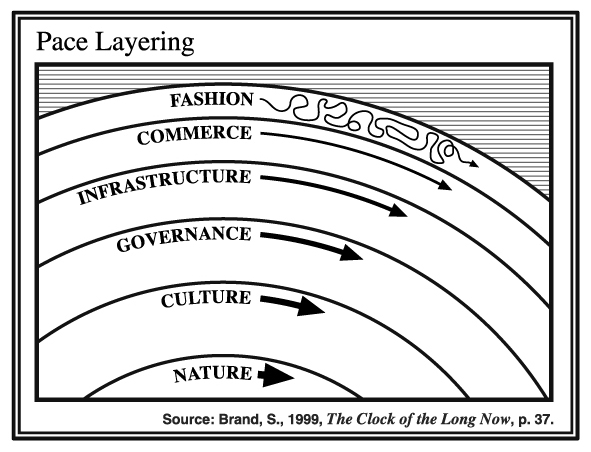
I often refer to this diagram from Brand’s book, The Clock of the Long Now when talking about how we think about time and our world:

pace_layering.jpg

So I was interested to learn of Jussi Parikka’s book The Anthrobscene. It is reviewed by Nora Khan, and explained on the Minnesota press site, its publisher:

“Smartphones, laptops, tablets, and e-readers all at one time held the promise of a more environmentally healthy world not dependent on paper and deforestation. The result of our ubiquitous digital lives is, as we see in The Anthrobscene, actually quite the opposite: not ecological health but an environmental wasteland, where media never die. Jussi Parikka critiques corporate and human desires as a geophysical force, analyzing the material side of the earth as essential for the existence of media and introducing the notion of an alternative deep time in which media live on in the layer of toxic waste we will leave behind as our geological legacy.”

— child labor and human trafficking is behind much of the labor providing the ores and minerals used in the making of our machines. The geology behind what we do is usually invisible to us, as so much is. It is important to be reminded. Time and responsibility, indeed.

Heidegger, Journalism vs. Trump, Translations

  • Journalism should stop “feeding the trolls”, as we’d say here in Silicon Valley, and Donald Trump and his flying monkeys are clearly trolls. A great strategy for this has been presented by Jay Rosen on Pressthink of how the press can execute it: report from outside the white house; don’t broadcast live events in order to protect your audience from lies; don’t amplify or repeat lies. Send interns, not top reporters, into press conferences.
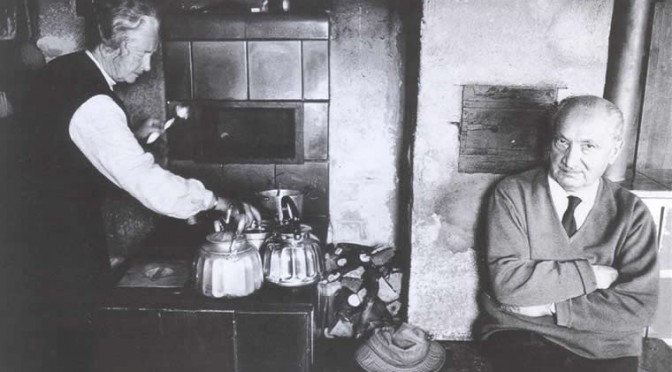
  • I’ve been rereading The Question Concerning Technology by Martin Heidegger.  Technology’s essence is not technological: it is a way of looking at the world as if everything is “standing reserve”.Everywhere everything is ordered to stand by, to be immediately at hand, to stand there just so that it may be on call for a further ordering. A tree is not a tree, it is subordinate to the orderability of cellulose; Humanity is reduced to what is calculable, manipulable, employable. Nature most of all. Viz:

    The hydroelectric plant is not built into the Rhine River as was the old wooden bridge that joined bank with bank for hundreds of years. Rather the river is dammed up into the power plant. What the river is now, namely, a water power supplier, derives from out of the essence of the power station. In order that we may even remotely consider the monstrousness that reigns here, let us ponder for a moment the contrast that speaks out of the two titles, “The Rhine” as dammed up into the power works, and “The Rhine” as uttered out of the art work, in Hölderlin’s hymn by that name. But, it will be replied, the Rhine is still a river in the landscape, is it not? Perhaps. But how? In no other way than as an object on call for inspection by a tour group ordered there by the vacation industry.

    Heidegger’s Black Notebooks were also translated into English a couple years ago, and I will probably never read them, as I’ve left off reading much Heidegger in the past couple decades. Have you read them? Here’s a primer in The New Yorker: Why does it matter if Heidegger was Anti-Semitic? Heidegger was a Nazi. This is especially relevant in the context of technology and the human, for obvious reasons.

  • I was shocked to learn how few books in translation Americans read. If you want to find some good reads, a good place to start is the long list from the National Translation Awards. I’ve got my eye on August, and already have a copy of Dandelions.
“Put a king over us”

The people came to Samuel and said, “Put a king over us, to guide us.”


Samuel  said, “This is what the king who will reign over you will claim as his rights: He will take your sons and make them serve with his chariots and horses, and they will run in front of his chariots.  Some he will assign to be commanders of thousands and commanders of fifties, and others to plow his ground and reap his harvest, and still others to make weapons of war and equipment for his chariots.  He will take your daughters to be perfumers and cooks and bakers. He will take the best of your fields and vineyards and olive groves and give them to his attendants. He will take a tenth of your grain and of your vintage and give it to his officials and attendants. Your male and female servants and the best of your cattle and donkeys he will take for his own use. He will take a tenth of your flocks, and you yourselves will become his slaves. When that day comes, you will cry out for relief from the king you have chosen, but the Lord will not answer you in that day.”


But the people refused to listen to Samuel. “No!” they said. “We want a king over us.  Then we will be like all the other nations, with a king to lead us and to go out before us and fight our battles.”


When Samuel heard all that the people said, he repeated it before the Lord The Lord answered, “Listen to them and give them a king.”

1 Samuel 8

Online Communities Gone Bad (and getting them back on track)

After my appearance on the podcast Masters of Scale, a lot of people have written to me for advice on managing their communities. Here’s one request and my response, which I posted with permission, in the interest of making the internet a more civilized place.

Things had gotten so bad in this founder’s community, that even employees were thinking of leaving. The team felt hamstrung by their users. He explains:

When we first started our community I was in there posting every day setting the tone. Over the years as the company scaled I chose to spend time on other things beside posting in the forum. Gradually over time things got bad…then really bad…now horrible. 5-10 members of the community have started berating everyone in between posting useful content. Do you have any principles or experiences I can draw upon to think about how to solve this?

Yes, I wrote back, this community has run amok. A garden needs both fertilizer and weedkiller. But most of all it needs a gardener. Go back in and participate as much as before. Community manage with a heavy hand. Promote good people, respond to them.  Make them shine. Build good admin tools to silence bad actors.

You have to take a “iron fist in velvet glove” approach; warn borderline cases, and discuss their behavior with them. Often they can be rehabilitated. But for those who will not change: ruthlessly delete the accounts of abusive people, irrespective of their contributions. Keeping 5-10 bad people have undoubtedly lost you dozens, even hundreds, that you don’t even know about. They’ve stifled other people who are still participating and darkened the atmosphere of the whole community.

Community management is art, not science. There is no black and white when dealing with people. Choose your community team carefully, and find people with good instincts. Have all members of the team participate in the community. And be present there yourself.

Heard, read and seen

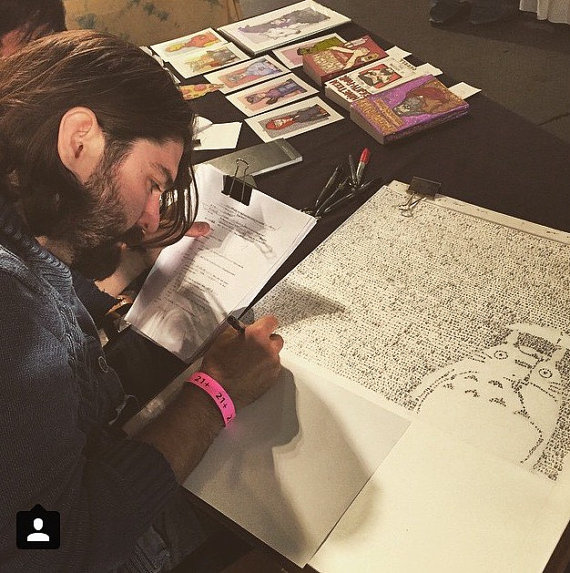
An image of Totoro, comprised of the entire screenplay written by hand in Japanese.

• My favorite anecdote from Emma Cline, author of The Girls, interviewed by Vendela Vida at City Arts and Lectures. Cline grew up in a family with 7 children, and on their birthdays each kid would get their very own box of cereal. They’d write their names on the box with a sharpie and guard it with their lives.

• I serve on the board of McSweeneys, the publisher of the Internet Tendency, a humor web site, the McSweeneys Quarterly Concern , a literary magazine, and lots of lots of literary fiction, poetry, non-fiction, children’s books and books that make the world better. The Quarterly and the Books are in actualy, physical print, beacons of beauty in a world starved for gorgeousness.  Certainly your holiday gift recipients should have some ideas, some poetry, some love, some beauty?


No difference at all

“I was working for the city as a janitor in a neighborhood elementary school and, in summer, collecting litter in the park alongside the East River near the Williamsburg Bridge. I felt no shame whatsoever in these activities, because I understood what almost no one else seemed to grasp: that there was only an infinitesimal difference, a difference so small that it barely existed except as a figment of the human imagination, between working in a tall green glass building on Park Avenue and collecting litter in a park. In fact, there may have been no difference at all.”

from A Visit from the Goon Squad by Jennifer Egan

2000 Index Cards, and Learning Languages

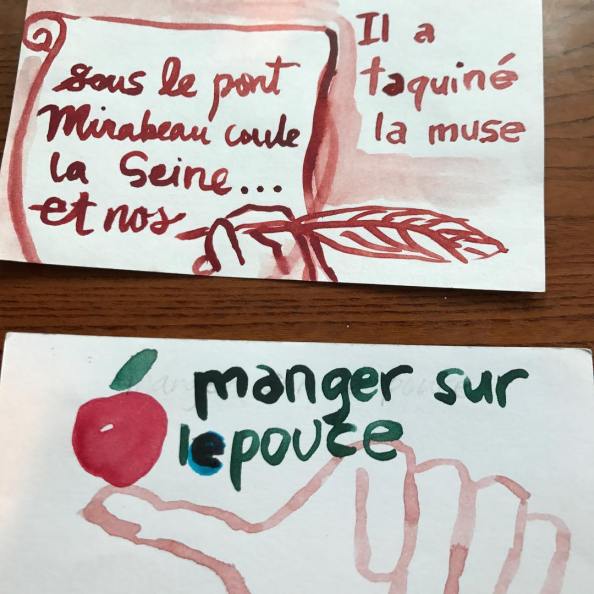
When I acquired 2000 index cards, my friends asked what they were for. Lots of things, but here I am using them for watercolored mnemonics for French phrases. Having conceded that Finnish is unmasterable, not only because of its grammatical complexity but because an English speaker in Helsinki never has a chance to speak it, I reconceived of myself not as a failed Finn, but as a potential European and decided I would master at least one European language. I was closer in French than Spanish so I’ve been working at it. Easy language, and solid literature too! To study languages I recommend two books, The Practice of Practice, which is about learning music, but is applicable to any learned skill, and Fluent Forever, which. It was from the latter book I derived this flash card method.

Another homeschooling parent told me her son learned his excellent, fluent Chinese by watching Chinese soap operas, and I was gratified to discover that you can watch most things on Netflix in French with French subtitles. I switched my movie viewing to French, my reading to French,  my podcasts to French, my dreams to French…