Bed for Dreaming: Caterina Fake interviewed by Natasha Boas

A conversation between Natasha Boas and Caterina Fake

Natasha Boas: The act of bringing a bed into a gallery–a private haven par excellence in a public space-carries so much meaning and engages with so many stories, fantasies, fears and desires. What happens in the act of sleeping in the bed in the gallery?

Caterina Fake: The first installation of Bed for Dreaming was at gallerist Aida Jones’s house, who generously agreed to host dreamers. It was installed in a home so that people would feel safe sleeping there. Aida acted as a proxy for “The Great Mother,” analogous to  the goddess figures from different spiritual and cultural traditions that fill the room—protective figures, goddesses of compassion. We called our sleepers “the dreamers” and wanted them to feel safe in unconditional positive regard. 

When Bed for Dreaming traveled to Minnesota Street Project, it was not possible for people to sleep there, and while we could create darkness, there could be no actual candles.  In place of dreaming, our dreamers can use the “dream objects” to tell their stories on the sand table. And many dreams have been sent to me, dreamed elsewhere. 

I created Bed for Dreaming as a response to the suffering in the world that we don’t have the means to handle. Nowhere is safe. Threat and crisis surrounds us. We are so scared and broken. We spend hours doomscrolling in a perpetual state of alarm. Throughout all this, we have lost connection to ourselves, our depth, our inner world. The installation invites visitors into that world, with hopes to create a sense of safety and calm, beauty and mystery.   

NB: What does candlelight make possible that electric light doesn’t?  What do colors and shadows from candlelight do to change perception? What happens in the dark that can not happen in the light of day?

CF: One marvelous writer on the subject of darkness is Junichiro Tanizaki in his book In Praise of Shadows. The darkness in Japanese homes of the pre-modern era were intentionally dark, and all of the beautiful furnishings and statues, the statues, the lacquer bowls, the gilding were meant to be seen by candlelight. As were the white painted faces of women who wore green-black lipstick.

He praises not only the beautiful interiors but also the dark—but perfectly clean—bathrooms of his youth, which today have become blindingly bright, illuminated with electric light like operating theaters, as if the dirt of our humanity can be exposed and expunged and disinfected. A whiteness that only tolerates the perfect, the shiny and new. Against it everything old looks dirty and corrupt.

David Batchelor in his book Chromophobia describes the home of an art collector which was seamlessly white with a white so white it was not even bleached, but was itself bleach.

Bed for Dreaming rebels against this state of affairs, against the tendency towards purification, whiteness and the intolerance of flaw, fault, or blemish. We see this appear in so many ways in our culture, not only in contemporary design, but also in the incessant judgment, purity tests and virtue-signaling. 

The installation was completely transformed at Minnesota Street Project because of the tremendous contrast of the darkness and dim light of the show with the bright white of the rest of the building. Bed for Dreaming  encourages people to be dappled, imperfect, odd, sensual, beautiful, human. To praise all things counter, original, spare, strange.  

NB: Dreaming is a gift that we all do not have access to. Scientists say everyone dreams, but not everyone remembers. What happens if a guest does not remember their dreams and has problems sleeping in such a context? 

CF: I was always amazed that any of the guests at Sophie Calle’s 1979 work The Sleepers were able to sleep at all, what with her sitting in the room with them and photographing them every hour! It’s like that Tehching Hsieh clock-punching piece—no sleep. Carsten Hollers installed a bed in the Guggenheim. Even wrapped in that snail shell, how could you sleep? Didn’t Tilda Swinton sleep in a picture window once? Fortunately our dreamers were solid sleepers. 

I am a polyphasic sleeper and sleep in two sleeps. Most people slept this way before electric light and the exigencies of a scheduled work day. That interstice between sleeps puts you in a hynogogic state, between dreaming and wakefulness, and it is where a lot of creativity, vision and imagination lives. I have my best ideas then, during the witching hour, the hour of the wolf. “Witching Hour” is the name of the Benjamin Moore paint we put on the walls at the Minnesota Street Project. 

NB: What will you do with the dream journal recordings? Do they become artifacts for future installations? 

CF: All the dreams that were written in the dream journal and I that have received from others are gifts. Many of our dreams are pedestrian and extensions of our waking life, but often they are numinous, as if we had traveled in a timeless realm, gone down into the underworld, met the immortals, touched the infinite. Everyone has a magic dream. 

From among the dreams I will make future artworks, whether they be future installations, paintings, sculptures or films remains to be seen. I have already sketched plans for some of them. This is ongoing work. I  am planning a show about portals, this place between, the liminal and the threshold, the gates of heaven or hell, the entry to the underworld. I have a proposal for another show called Temple of Dreams. Ferran Miquel has composed music based on the dreams which he will be playing at the end of the installation of Bed for Dreaming and we are collaborating on a surrealist opera.

NB: We both love the book From the Mixed-Up Files of Mrs. Basil E. Frankweiler, the children’s novel by E. L. Konigsburg about the siblings who run away from home to live in the Metropolitan Museum of Art in New York City, and become engrossed in solving the mystery of an enigmatic statue they believe might be a Michelangelo.

The Musée Picasso in Paris project invites artists into the museum to spend the night and write or make work about it. It flips your script in a way.  People do want to be surrounded by art!  That must be why there is such a collective fantasy around sleeping in museums. 

CF: Yes! There seems to be a developing idea around this. There is also a book published by Fern Books, Like a Sky Inside, about a writer who finds a way to spend the night at the Louvre. And I understand this desire well, because yes, I read and reread From the Mixed-Up Files of Mrs. Basil E. Frankweiler as a child, repeatedly checking it out of the library. I would think about  it every time I went to the Met or any other museum. Because I wanted to live surrounded by art: The Mountain, Fragmentary Head of a Queen, tapestries, medieval drinking games, Madame X, the Egyptian sarcophagi–all of it. It’s one of the most beautiful and best places in the world. I am willing to go with “best”. Best place in the world. Who wouldn’t want to sleep there? 

…………..

Bed for Dreaming will be at The Minnesota Street Project at 1275 Minnesota Street, San Francisco through January 30, 2026 Tu-Sat 11-6. There will be an artist talk on January 29, 2026 at 6:30 PM at MSP.

Please send dreams to bedfordreaming@gmail.com

Reading by Night: The Makioka Sisters

If you are an avid follower of all my online doings, you may have seen that I have a relatively new Instagram account, Reading by Night. I also read by day, but it is so named because I am a devotee of The Hour of the Wolf–the wee hours, as they’re sometimes called, the interstice between Two Sleeps. Also reading by night is better! Romantic and mysterious, interruptionless.

I have just read The Makioka Sisters, by Junichiro Tanizaki, written in 1957. Kindle and many newspapers and blogs will tell you how long it takes to read something. I don’t think that’s a great way to decide what to read, I wish such estimates didn’t exist. But you can tell when you hold this book in your hand: it’s going to take a while. You flip to the end: 600 pages. I had heard it would be worth it. It is. It was.

The Makioka Sisters is a masterpiece of post war Japanese literature. A perfect portrayal of the pretension, snobbery and sufferings of a declining aristocratic family from Osaka, four sisters, trying to get one of them married, and trying to keep the youngest, most modern one from destroying what little remains of the respectability the family once enjoyed.

As WWII encroaches inexorably and illness and scandal descend, you feel their losses: the grace and beauty of the firefly hunting parties, the repose and solitude of the lost country estates, occasions for elaborate kimonos, traditional songs and dances, the cherry blossoms of Kyoto, the temples and rituals. The sacred trampled by the profane, like sakura.

But much was gained: women freed from subordination to make their own way in life, release from the straitjackets of class and hierarchy; and much that was exciting and new: train travel, television, a sense of freedom, Europeans coming to Japan, new food, expansion—and Western dress.

This is the Japanese women’s version of the Radezsky March by Joseph Roth, another masterpiece, in which gaudily uniformed men in fanciful dress and plumed helmets rattled their sabres and sat stiffly erect on prancing horses—while the Austro-Hungarian empire collapsed around them.

I had forgotten how much I’d liked Japanese literature! I went to the shelf to look: Kobo Abe, Kenzaburo Oe, Murakami, Yoko Ogawa, and the first Japanese novel I’d loved: Snow Country by Yasunari Kawabata. More recently, Yoko Tawada. I think I’ll go back and read them again.

P.S. Why were four Chinese women put on the cover of this book? Maybe the art department didn’t have the equivalent of fact checking. The women’s faces are quite Chinese; one of them is even wearing a Cheong Sam! So I put a Japanese doll, one of the themes of the book, next to it (reposing against a Chinese pillow)

What to call Prostituted Women & Children

I’ve been working a long time to help protect women and children who have been forced into prostitution through their addictions, poverty, history of sexual abuse and vulnerability, and find that the language used to describe these typically abused and disempowered women is really problematic. I agree with this from Ruchira Gupta, the activist and documentary filmmaker widely recognized for her work as an advocate for prostituted women and children:

Gupta also realises how, over the years, sensitive subjects get glossed over with problematic vocabulary. “We do not use the term ‘sex worker’ anymore because we believe it’s so inherently exploitative that we do not want to define it as work under any circumstances. So, we use the term ‘prostituted child’, because there is no such thing as a child prostitute—someone did it to the child. And we use the term ‘prostituted woman’. We realise the patriarchy of the system that is exploiting the vulnerabilities of these girls and women.”

Vogue India

(As an aside, I was just talking with a friend about how we used to read Vogue “for the articles”; you don’t expect topics like this from Vogue, and yet I read so many like it. This is from Vogue India, and India is of course known as one of the worst places to be a woman–and is often ranked the worst–in multiple studies. It was often first, with Afghanistan coming in second, but they may now have switched spots.)

Hooray, Hooray the first of May!

Vappu, the Finnish holiday celebrated on May 1, turns out to be the shortening of the name of Valpurga, and is a celebration of Saint Walpurga, a German saint, known for her enthusiasm for witch-burning. Christian holiday-making from that era specialized in the transformation of nature-based and animistic pagan celebrations into Christian holidays of extreme misogyny. The first of May is also Beltane, the Celtic and Gaelic pagan celebration of the beginning of summer, marked by driving cattle to their summer pastures (or here in urban Helsinki, by changing your car from winter to summer tires.)

It’s also when Finnish students wear their graduation hats and you will find balloons, confetti and picnics. It wouldn’t be a holiday without a special pastry either, in this case Tippaleipä — bread that looks like brains. There’s something sweet for every event, large or small, like the pastry that celebrates ice skating season.

As with so many pagan holidays, there is fire, as Wikipediat notes: “Special bonfires were kindled, and their flames, smoke and ashes were deemed to have protective powers. The people and their cattle would walk around or between bonfires, and sometimes leap over the flames or embers. All household fires would be doused and then re-lit from the Beltane bonfire.”

It’s also International Workers Day. Maypole dancing also occurs apparently, though I’ve never witnessed this. The first Mayday celebrations were Roman, and were associated with Flora, the flower goddess. Flowers are meant to appear, but it was snowing here this morning…

Fraudulent reviews on Indeed.com, with an assist from Indeed itself

I hadn’t visited Indeed.com for years, but I had a job I wanted to post somewhere, so was seeking job posting sites, and at the same time learned that someone I knew was about to take a job in Portugal at a company called Teleperformance. She sent me a link to a YouTube video about the company, posted by the company itself.

Something about the video seemed suspicious in that “too good to be true” way, so I searched for reviews, and found a page on Indeed.com about Teleperformance. The reviews were indeed horrifying! They are in many languages, and I can only read French and English, but those were enough. It sounded like a nightmare of a job, attracting young people under false pretenses, paying them almost nothing, putting them up in terrible, moldy apartments, making women feel unsafe, making them stay for 9 months in order to get their flight refund…it went on and on.

But there were two other things I noticed. Indeed.com had pinned a positive review to the top of the page. Maybe they are paid to surface positive reviews? Unclear. And it explained a bit too much about the business, as if it were coming from the company itself. However, the other thing I noticed was that all of the positive reviews were completely without specifics.

You can hire bands of freelance reviewers on places like Fiverr to post positive reviews to Yelp, Indeed, Glassdoor, etc. Often these can be easily identified by their lack of specificity. If you removed all the non-specific positive reviews, Teleperformance would be left with just bad-to-terrible reviews.

Defrauding customers on review sites is also illegal. So I have reported the fraud here, but I am guessing that this particular company is not the only one stacking the deck. And they’re doing it with an assist from Indeed.com itself.

Here is where you can report fraud to the FTC. There is an ocean of this stuff, and obviously this report will get drowne in a sea of similar such reports. How can we get integrity back into the internet? Why can’t review sites maintain their integrity? Should we wipe the internet and start again? Sometimes I think we should.

Recommendations for Migri

After talking to friends hoping to move from Silicon Valley to Europe, and going through a frustrating year of working with Migri, I wrote to Director of Migri Jari Kähkönen in September and included a list of recommendations for attracting talent to Finland.

Here are the recommendations (and rationale):

A growing number of my colleagues now work remotely from Iceland, Portugal, New Zealand, the Netherlands, Bali, Costa Rica, Taiwan, Singapore, Estonia, Germany and other places. Many expect to return to the SF Bay Area after the pandemic, but some will likely stay in their new home countries.

This is an opportunity for Finland. I hope to move my family here because of Finland’s reputation as a country with a stable social democratic government, benefitting from a high level of social cohesion and trust, which is enormously appealing in uncertain times. The education system has a strong reputation overseas, and the quality of life in terms of healthcare, education, technological sophistication, progressive politics and work/life balance are tremendously attractive to foreigners. The fact that most urban Finns speak English, and that it is the official language in many companies, is also important. Finland is seen overseas as technologically advanced, enlightened, stable and supportive. If you wish us welcome, others will follow.

1. Fast track. Create a fast track for highly qualified talent and a separate unit that manages it end-to-end. Remote identification, 48h processing time. These people will make outsize contributions to the Finnish economy. Do not rely on your existing Migri processes if you wish to welcome and retain them.

2. Remote worker residency. A type D visa for U.S. tech employees working from Finland, inclusive of their families. Requiring Silicon Valley companies to create Finnish subsidiaries for temporary remote workers is a nonstarter. Even multinationals like Facebook and Google prefer to retain their remote workforce in their U.S. cost centers.

3. Investor visa. For investors applying for residency to Finland, inclusive of families. Due to their work many investors wish to keep both U.S. and European residencies and they should be able to spend part of the year in Finland. 13 other European countries offer investor visas. New Zealand has found their investment in New Zealand multiplies in a few years.

4. One step process. Permanent home address registration, national ID card, strong identification, and Suomi.fi and Omakanta credentials should be automatically issued with the residency permit. The current Kafkaesque morass of in-person appointments, paper documents and confusing online flows should be replaced with a modern automated system.

5. English language schools. Finland fails to capitalize on its reputation for excellent education by not investing in a meaningful way in an English language school path. Despite claims about increased capacity, only one of Helsinki’s schools offers an English language track and the European School & handful of private schools in the Helsinki area are full with waitlists. New English language school tracks should urgently be established.

6. Targeted talent attraction. I know from experience from my investments that talented individuals move in groups. Hire a team of American-Finnish marketers located in the U.S. to compete with the other countries. The window of opportunity has opened, and Canada and others are advertising on billboards on Silicon Valley’s 101 freeway.

Tech companies’ shift to remote work coupled with climate change, the pandemic, China’s expansive authoritarianism and U.S. domestic politics make Finland surprisingly attractive. Now’s the time to act.

I recommend working with a service design firm on designing the fast track process.


I have not yet received a response.

September Reading

My September reading was not quite as strenuous as last month, given that I read Middlemarch in August, from which I am still feeling the glow of accomplishment, a loathing of Casaubon and a sense of infinite depths.

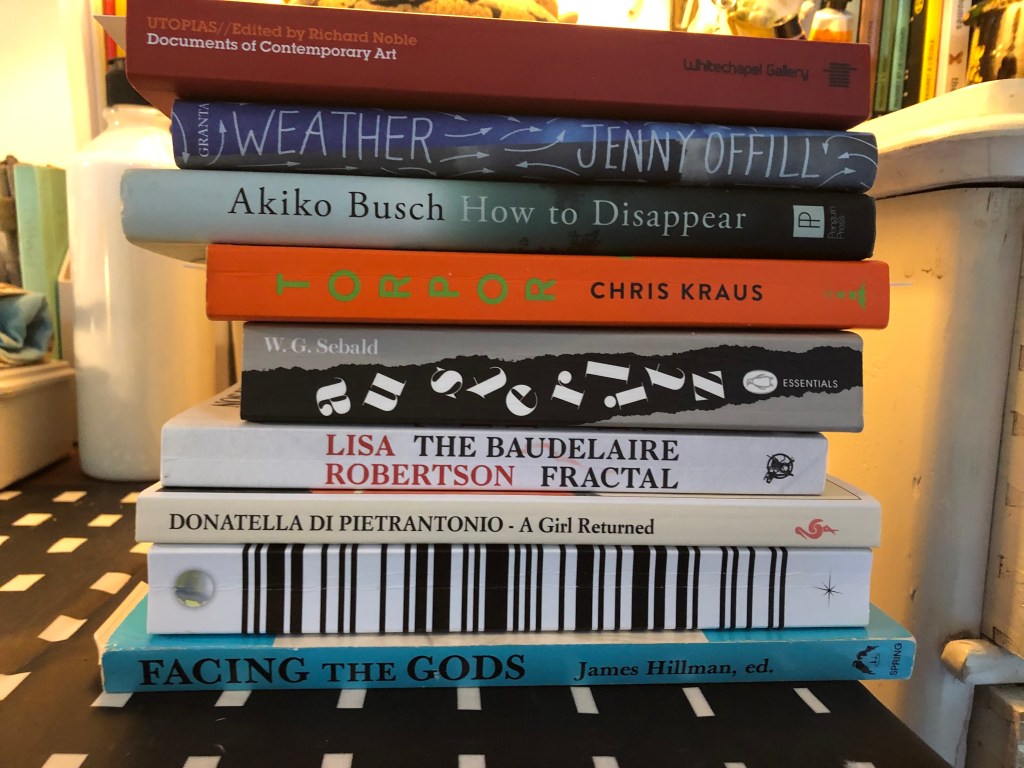
Here you’ll see just one masterpiece–Austerlitz–and two books I didn’t quite finish, that I skimmed and eventually put down. Those are How to Disappear and Torpor. I had enjoyed the quirky, downbeat, pathetic style of Kraus’s other books, I Love Dick and Aliens and Anorexia, but the grimness of the times we’re living through made it impossible for me to make it through this one, which included a tour through Romania to adopt an orphan, and an accounting of the horrific abuse and neglect babies and children suffered under the Ceausescu regime, the failed and failing relationship, the struggle and the struggling. But A Girl Returned was also the story of an abandoned child–in this case an adopted child “returned” to her birth family. The book also had its horrific moments but was redeemed by the love she found with her birth sister Adriana, a childhood friend, Patrizia, and the reconciliation of sorts with her adoptive mother. And the girl’s insistence on taking her own life back after she had been thrown among strangers. It was purer-hearted and the pure-hearted is what we need right now.

Sometimes I linger in bookstores, browsing the “S” section, hoping a new Sebald book would appear. Since it won’t, I read the existing ones over and over and over and each time they seem as if I had never read them before. Except The Emigrants which I almost have memorized. Austerlitz is a book I read often.

Weather, much lauded, much recommended, had been partly derived from other people’s work. I recognized some of the (unattributed) podcasts and articles she’d gotten the material from. As such, I couldn’t ally myself with the book; I was already allied with the original material. But I liked the paragraph – paragraph – paragraph style.

And the rest of September’s reading? art criticism and Jungian psychology. Now, I am reading myths.