Dave Eggers on the Ingenious podcast

Listen to the show on Apple Podcasts, Spotify, or wherever you listen.

“We feel that to reveal embarrassing or private things, like, say masturbatory habits (for me, about once a day, usually in the shower), we have given someone something, that, like a primitive person fearing that a photographer will steal his soul, we identify our secrets, our pasts and their blotches, with our identity, that revealing our habits or losses or deeds somehow makes one less of oneself. But it’s just the opposite, more is more is more – more bleeding, more giving. These things, details, stories, whatever, are like the skin shed by snakes, who leave theirs for anyone to see. What does he care where it is, who sees it, this snake, and his skin? He leaves it where he molts. Hours, days, or months later, we come across a snake’s long-shed skin and we know something of the snake, we know that it’s of this approximate girth and that approximate length, but we know very little else. Do we know where the snake is now? What the snake is thinking now? No. By now the snake could be wearing fur; the snake could be selling pencils in Hanoi. The skin is no longer his, he wore it because it grew from him, but then it dried and slipped off and he and everyone could look at it.

And you’re the snake?
Sure. I’m the snake. So, should the snake bring it with him, this skin, should he tuck it under his arm? Should he?

No?
NO, of course not! He’s got no fucking arms! How the fuck would a snake carry a skin? Please.

― Dave Eggers, A Heartbreaking Work of Staggering Genius

We’re the snake.

And I have a dog in this fight.

Because I deeply believed at one time that we were all the snake and that by being the snake (at least how Dave is describing it here, back in his very first book) the more we showed of ourselves and left our skins behind, the better. Of course that doesn’t mean we should all go online and tell on ourselves. But we should be able to do what writers do (or artists, musicians—anyone really—priests, dog trainers, maintenance workers, phlebotomists) which is make something which, and be somebody who, reveals ourselves and is true to our warty, actual selves. Not be too precious about ourselves. We sound so young when we say this, but: Let’s stay true to the people we were and the dreams we had.

The story about how indigenous people didn’t want to be photographed because they feared it would steal their souls has new currency in the age of AI. I know this first hand. I was a big advocate for free culture and the open software movement in the early aughts, implementing Creative Commons licenses in Flickr, thereby creating the largest library of shareable media in the world, at least, at the time. I shared my own photos with Creative Commons licenses and joined the Creative Commons board. Artists and filmmakers and other creative people were able to use them to make fantastic things. Jonathan Coulton wrote a song (and made a short movie) named after Flickr using the Creative Commons licensed photos—that’s MY dog with glasses!

Flickr photos appeared in low budget movies, in band posters, in this incredible installation by Erik Kessel at a gallery in Amsterdam. The installation featured prints of every single photograph uploaded to Flickr within a 24-hour period. The more than a million photos are piled up nearly to the ceiling, and spill over into several rooms.
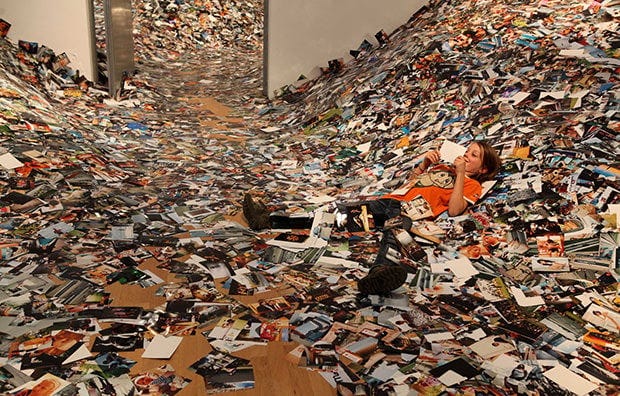
I never got to see it in person. It was an artwork about how we are drowning in photos, in media. How no one can look at all of the photos. It was still a newish idea at the time, 2011. What a wonderful time that was.

It was an era of optimism and trust. We trusted humanity. We knew people to be honest, well-meaning. We trusted technology, audiences, artists—there was so much trust, we were just bursting with trust. It seems almost inconceivable now, so jaded and weary we’ve become. We believed that people are essentially good, operating in good faith, trustworthy, reasonable. We were not wrong. But we discovered that even if 999 out of a thousand people are honest and trustworthy, one bad actor can be incredibly destructive. A mob of angry tweeters. Or, enemy nations.

I talked about this with Chris Anderson, who had been the Editor-in-Chief of Wired magazine, on my last podcast Should This Exist?. He had an open source drone company, 3D Robotics, and they open sourced their drone software. A lot of hobbyists hacked their Lego Mindstorms and had a lot of fun making flowers or M&Ms rain down on children’s parties, searching for lost elephants in vast African wildernesses and other great things. Then one unhappy day, on the front page of the New York Times, Chris learned that ISIS had been using his drone software to kill people.

This was about as bad of a consequence as you can imagine. The worst consequence of sharing something online. But it was also happening in my world, the online world. Media, social media, was becoming more and more toxic. We had started out as the aforementioned snakes, sharing our photos, jokes, stories, poems, lives. But at many of the hosting companies, it was no longer about sharing; a lot of it was about stealing. Harvesting and exploiting your “data”, which you had thought of as your life. To my surprise, chagrin and increasing anger, I realized that the Creative Commons licensed photos on Flickr were being used to train AI. That even though no human could ever look at every single one of the photos in Erik Kessel’s artwork, or in the Creative Commons archive, or anywhere on the internet, a computer could.

Another conversation I had during the first season of Should This Exist? was with Sam Altman of OpenAI, a company we now know best as the maker of ChatGPT, but which at the time was a non-profit looking to protect humanity from the consequences of what was in the process of being invented. Money came, moral compasses spun around and lost true north—we know the rest. And now we’re seeing the results, watching the whole experiment unfold in real time: people’s faces and data and art and words being stolen, repurposed and put into formats and contexts they never intended or wanted, exploited for purposes that hadn’t existed when they innocently shared pictures of their weddings and kittens online, swindled and diddled and flimflammed and worse. All those words and images, pressed into service for manufacturing lies, flipping elections, and creating enemies where once were friends.

Which brings us to today’s podcast with Dave Eggers. He is the writer, artist, philanthropist and co-founder of 826 Valencia, a non-profit tutoring center for kids that teaches the next generation reading, writing and how to tell their own story. Which seems a paltry effort when you look at the giants and masters of the tech universe thrusting their rockets into space and colonizing everyone’s brains. Just patiently teaching a kid to read and write. Dave, who stands for a value system that is contrary to all this.
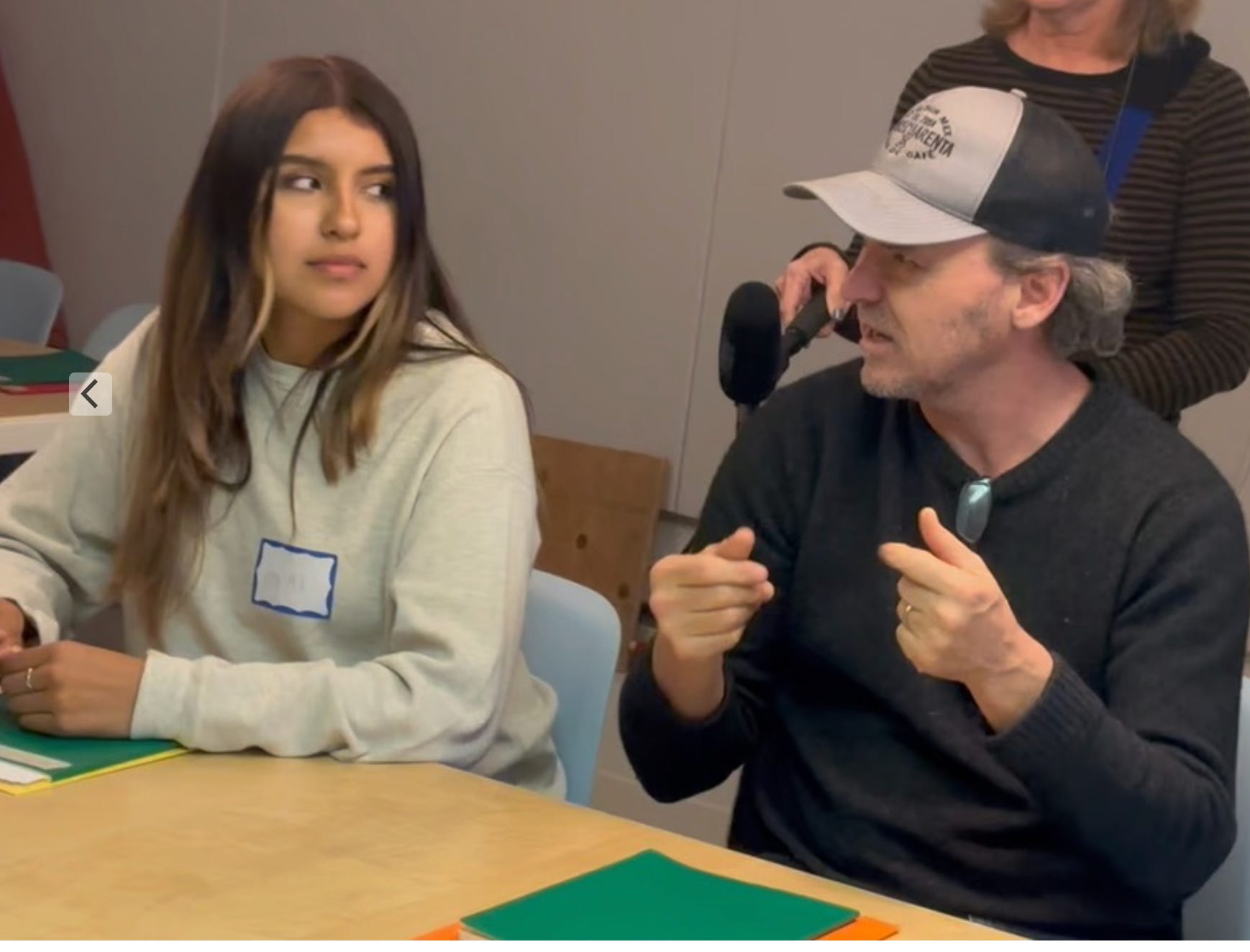
Dave and I go way back. We worked together circa 1996-8, at Salon.com, one of the very first online media publishers, which published, and still publishes, thinky articles on society and culture. They also host thoughtful online conversations and civil discourse. Again, it was an amazing time to be online.

Now I’m on the board of McSweeneys, the publishing company that Dave also founded. It publishes books and magazines, old media. So Dave and I have invested a lot of our energy into making places and spaces for writers doing creative work, finding an audience and getting paid. But these are fraught times for writers. The writers in Hollywood are on strike, AI is taking their jobs, teachers are saying the high school essay is dead. You’re here too and you’ve seen it—there’s a lot of dread to go around. Think we’re reactionary luddites? I don’t think so. Techno-optimists turned tech skeptics, maybe. I think we’ve all become a lot more wary since our salad days.
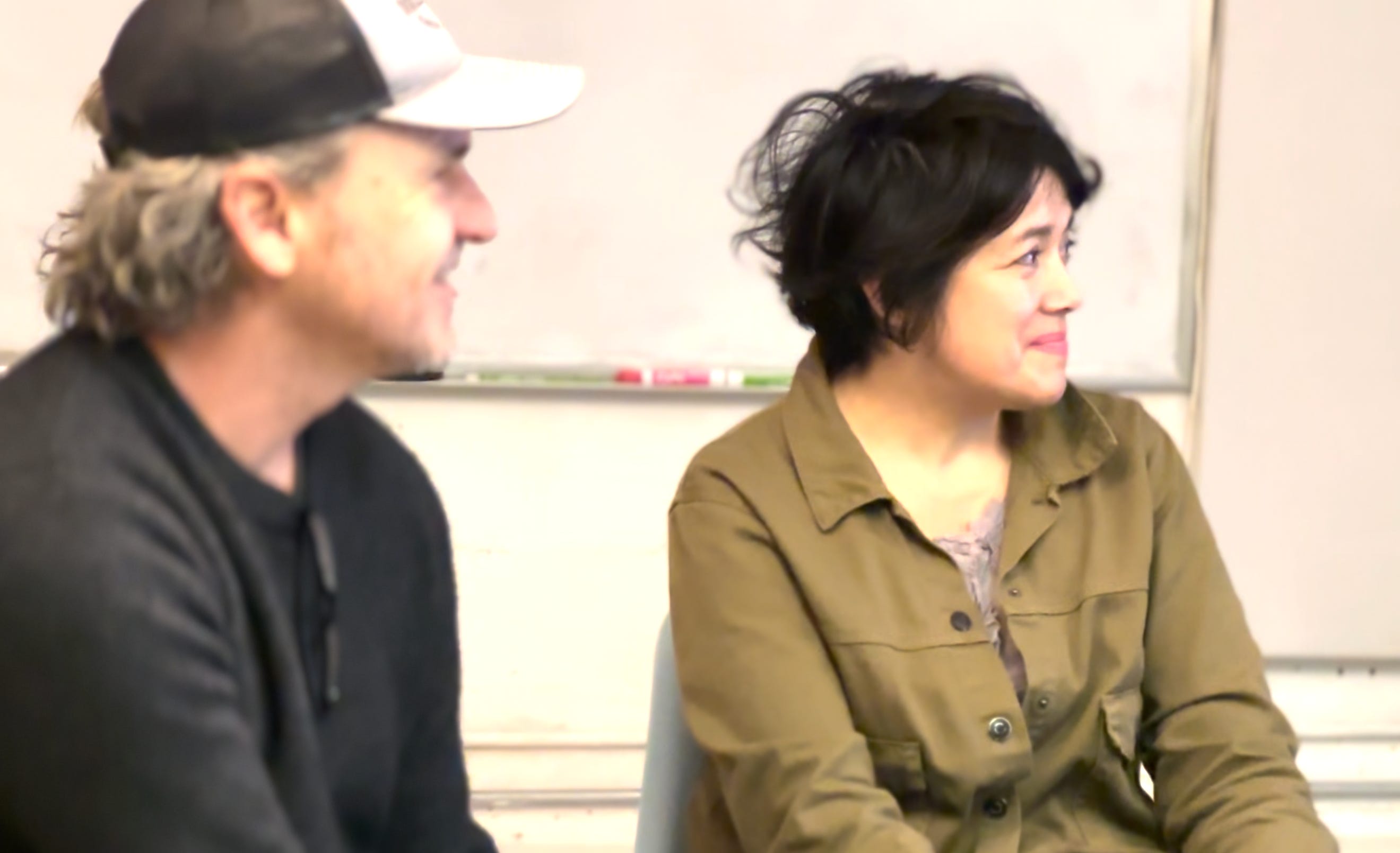
In any case, there’s a lot of these values and thinking and ideation in this podcast. It is a special episode because Dave and I are old friends, and share a lot of the same hopes for the humans. So give it a listen!

I’m so proud of this podcast, Ingenious, which was the co-creation of me and my friend and producer Mary Beth Kirchner, with the tireless assistance of Jyri Engestrom and Beth Malin and the Yes VC team and a host of others. Including the brilliant guests who have always found a way to surprise me, energize me and pave new avenues of thought. I hope it’ll do the same for you.

Thanks Dave, for this and all you do. How far that little candle throws his beams! So shines a good deed in a weary world.


Some resources:

Complex Personhood

Because I am teaching a course on dystopian literature I am re-reading 1984 and Brave New World, while also rewatching Avery Gordon’s talk on The Utopian Margins, and re-reading the parts of Ghostly Matters that deal with Complex Personhood. Here’s an excerpt:

“It has always baffled me why those most interested in understanding and changing the barbaric domination that characterizes our modernity often–not always–withhold from the very people they are most concerned with the right to complex personhood. Complex personhood is the second dimension of the theoretical statement that life is complicated. Complex personhood means that all people (albeit in specific forms whose specificity is sometimes everything) remember and forget, are beset by contradiction, and recognize and misrecognize themselves and others. Complex personhood means that people suffer graciously and selfishly too, get stuck in the symptoms of their troubles, and also transform themselves. Complex personhood means that those called ‘Other’ are never never that. Complex personhood means that the stories people tell about themselves, about their troubles, about their social worlds, and about their society’s problems are entangled and weave between what is immediately available as a story and what their imaginations are reaching toward. Complex personhood means that people get tired and some are just plain lazy. Complex personhood means that groups of people will act together, that they will vehemently disagree with and sometimes harm each other, and that they will do both at the same time and expect the rest of us to figure it out for ourselves, intervening and withdrawing as the situation requires. Complex personhood means that even those who haunt our dominant institutions and their systems of value are haunted too by things they sometimes have names for and sometimes do not. At the very least, complex personhood is about conferring the respect on others that comes from presuming that life and people’s lives are simultaneously straightforward and full of enormously subtle meaning.”

Complex personhood might be the thing that Big Brother, your enemies, totalitarian regimes, institutions might be most afraid of, and which they are working tirelessly to suppress. To accept and make space for another person’s complex personhood can be challenging as an individual, and in systems, be they software, constitutions, laws, governments, etc. it can be even more challenging, since there will almost always be someone who doesn’t have a neat space in the grid, and everyone is an exception to someone or something somewhere.

2000 Index Cards, and Learning Languages

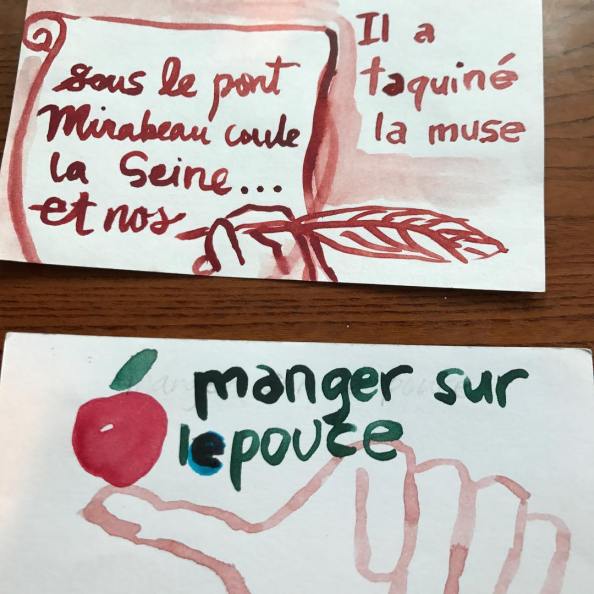
When I acquired 2000 index cards, my friends asked what they were for. Lots of things, but here I am using them for watercolored mnemonics for French phrases. Having conceded that Finnish is unmasterable, not only because of its grammatical complexity but because an English speaker in Helsinki never has a chance to speak it, I reconceived of myself not as a failed Finn, but as a potential European and decided I would master at least one European language. I was closer in French than Spanish so I’ve been working at it. Easy language, and solid literature too! To study languages I recommend two books, The Practice of Practice, which is about learning music, but is applicable to any learned skill, and Fluent Forever, which. It was from the latter book I derived this flash card method.

Another homeschooling parent told me her son learned his excellent, fluent Chinese by watching Chinese soap operas, and I was gratified to discover that you can watch most things on Netflix in French with French subtitles. I switched my movie viewing to French, my reading to French,  my podcasts to French, my dreams to French…

Ph.D program vs. Time-Life book

…I attended a political theory Ph.D. program at the University of Massachusetts at Amherst. Something happened there. One day I was reading a Time-Life book about the painter Goya. I forget who the king was at the time, but he was one of the few enlightened kings of Spain. In the capital, there was a lot of crime. Men wore these big capes and hats, which made for a great disguise. The king was mad about all the crime, so he made that outfit illegal, but then there was a riot because me were so attached to the capes and hats. So the king repealed the law. He found a new adviser and said, Look, youve got to stop all this thieving. The new guy said, Don’t worry, Your Majesty, I got it covered. And the next day, he made the cape and hat the uniform of the executioner, who worked out in the open every day. People stopped wearing them just like that. Nobody wanted to be identified with the executioner. And I thought, I’ve learned more in reading this one stupid page in this Time-Life book about Goya than I have in my Ph.D. program. So I quit.

– Walter Mosley, interviewed in The Paris Review.

Lighting Their Fires

I just reread this review of Lighting Their Fires by Nat Torkington, which had this very valuable list of “lessons” for children (and their parents). It’s a child-rearing book, which I haven’t read, but that I’ve already benefited from. So:

The lessons for parents and kids:
* punctuality,
* use time valuably,
* care about and learn from the past,
* repeat and repeat the values,
* embrace an art and learn time management, focus, etc.
* put away distractions,
* develop a personal code of behaviour (he uses Kohlberg’s six levels of motivation)
* radio, models, board games, getting good at music and other arts, reading all build focus. TV and games do not.
* the importance of decisions and that they be good ones,
* to recognise that they are making decisions every day,
* spotting and discussing decisions in novels, plays, and movies,
* if something’s worth doing, it’s worth doing well,
* actions have consequences, there are good outcomes and bad, strive for excellence, lose the sense of entitlement,
* consider your alternatives,
* in the arts, try for excellence not adequacy,
* allowances not tied to chores—chores are responsibility, and the reward is the job well done,
* identify substandard work and require it to be done to standard, otherwise there are no standards,
* be self-less,
* work with groups not individuals, so all can recognise and appreciate and celebrate the hard work of others,
* do the right thing for the right reasons,
* be able to do the right thing without acknowledgement or praise (humility),
* to be able to delay gratification.

Along the way, lots of great quotes. Over the library of Thebes: “Medicine for the Soul”. Mark Twain’s alleged line, “The man who does not read good books has no advantage over the man who can’t read them.” Martin Luther King, Jr: “If it falls to your lot to sweep the streets, Sweep them like Michelangelo painted pictures, Like Shakespeare wrote poetry, Like Beethoven composed music.”

Storytelling, Narrative and the Utility of Knowledge

Why are we so intellectually dismissive towards narrative?” he asks. “Why are we inclined to treat it as rather a trashy, if entertaining, way of thinking about and talking about what we do with our minds? Storytelling performs the dual cultural functions of making the strange familiar and ourselves private and distinctive. If pupils are encouraged to think about the different outcomes that could have resulted from a set of circumstances, they are demonstrating usability of knowledge about a subject. Rather than just retaining knowledge and facts, they go beyond them to use their imaginations to think about other outcomes, as they don’t need the completion of a logical argument to understand a story. This helps them to think about facing the future, and it stimulates the teacher too.

– Jerome Bruner

Jerome Bruner died this week. He had lived well into his 90s and was working until the end.


Further Reading:
Actual Minds, Possible Worlds Bruner argues here that there is too much emphasis on the logical, rational and scientifically oriented parts of cognition, and too little on what he calls its “narrative” aspects, which are the source of all great storytelling, drama, myth and persuasion.


Acts of Meaning In which Bruner asks us to focus not on the mechanistic, computer-inspired way of looking at thinking, but give our focus to the rich, evocative, meaning-making aspects of our minds.

Youth sports are destructive to family life

Soccer KidsI was in a meeting the other day in which we went around the table and introduced ourselves to each other. We were meant to describe our personal, non-work lives, and some people named hobbies, or told about their recent vacations, but 60% or so, when asked what they did outside of work, said they drove their kids to their sports and soccer obligations, and were slaves to their children’s sports schedules.

I’ve found it’s nearly impossible to invite friends with traditionally schooled children to do things spontaneously on weekends– have a picnic or go hiking on a beautiful day, go out for dinner. “Sorry, Tommy’s got baseball” or “Can’t today, Melanie’s soccer practice” is the inevitable reply, Fortunately homeschooled kids seem to do a lot less organized sport and seem less invested in conforming with suburban social expectations. If you live in the suburbs, participation in team sports seems to be all the social activity on offer, for parents and siblings too.

What an astonishing loss of life. Is it worth it to lose all that time with family and friends? The losses are steep. In a post on Mom’s Team, a blog for “Sports Parents”, Jeannette Twomey lists the things her family has missed:

“Over the years, we saw one family activity after another bow its head to youth sports. Dinner at home, reading before bedtime, visits to grandma’s house, household chores, games in the backyard, picnics, weekend jaunts into the countryside, camping trips, school vacations – all casualties of the children’s sports schedule.”

The rest of the family generally bears the brunt of one kid’s involvement in sports. How much lost time together, how many things missed? And why value one kid’s time over the other kids’ time? It boggles the mind.

Generally team sports  are not lifelong sports. You don’t see 50 year old men playing soccer or hockey. Lifelong sports are things like skiing, tennis, dancing, yoga running–70 year olds are still doing these. And the whole family can do them together.

Bloom’s Taxonomy of Cognitive Processes

I have been thinking about thinking, and found this useful taxonomy by Benjamin Bloom, who in 1956 devised a taxonomy to discriminate between levels of cognitive thinking. The article notes that although the original intention of the taxonomy was to facilitate communication between educators and psychologists in the area of test construction, research and curriculum development, it has been found to be useful in distinguishing areas of study and classroom activities based on the taxonomy.

Bloom’s Taxonomy consists of six levels:

Knowledge
Recall or recognition of specific information

Comprehension
Understanding of information given

Application
Using methods, concepts, principles and theories in new situations

Analysis
Breaking information down into its constituent elements

Synthesis
Putting together constituent elements or parts to form a whole requiring original, creative thinking.

Evaluation
Judging the value of ideas, materials, and methods by developing and applying standards and criteria

There’s a path from the lower-to-higher level thinking, knowledge to evaluation which can be led by teachers through the use questioning, discussion and tasks.

The article also notes that while students need to be exposed to experiences at all levels of the Taxonomy, opportunities to work at more advanced levels are vital for gifted students. Often their advanced knowledge and comprehension skills enable them to progress more rapidly to higher levels of thinking, such as analysis, synthesis and evaluation.

Teachers dislike creative children

Do teachers dislike creative children in spite of their assertions to the contrary? 96% of teachers say that daily classroom time should be dedicated to creative thinking. And yet they seem biased against the very children whose thinking is most creative. At school, creative children are punished rather than rewarded, and the system seems designed to extinguish creativity. In spite of all the lip service.

The characteristics that teachers value in the classroom are those associated with the lowest levels of creativity. Teachers want students to be responsible, reliable, dependable, clear-thinking, tolerant, understanding, peaceable, good-natured, moderate, steady, practical and logical. Creativity is not moderate or logical. It is associated with characteristics such as determined, independent and individualistic, people who make up the rules as she goes along, divergent rather than conformist ways of thinking. You can read some of the research in this article.

120229-Finger-Painting

For good reason Ken Robinson’s talk, Do Schools Kill Creativity? is the most viewed talk on the TED web site. “If you’re not prepared to be wrong, you will never come up with anything original,” he says, and rightness and wrongness, as anyone who has ever received a graded paper can attest, is the very backbone of education.

The gulf between rhetoric and reality isn’t really that surprising.  It’s nearly impossible for a teacher, outnumbered by his charges, to help the rebels and mavericks flourish in an environment requiring more supervision than vision. The system is set up for teachers to prefer the obedient.


Sesat School in Wired

homeschooling - the cooks

I’m happy that Jason Tanz, who has written before about the sharing economy, wrote an article about homeschooling for Wired Magazine: The Techies Who Are Hacking Education by Homeschooling Their Kids. It gets across the entrepreneurial and DIY nature of the self-taught, and how the future will require us to be more inventive, take responsibility for our own education and be more entrepreneurial in our lives, education and pursuits. We were also happy that our micro-school, Sesat School, was included in the article.

Most of my interview was not included in the article, and unfortunately the one quote that was included made it seem as if I were endorsing an exclusive, privileged education that readers should “feel free to roll [their] eyes” about. Nor am I anti-public school or anti-democratic. This was unfortunate.

My public school education included a love of poetry and classical music–I was not homeschooled, and in the article it is implied that my experience has something to do with homeschooling. It did not. I was speaking in the context of what was good about public school education, and how being different didn’t hurt, but helped me in life.

In the interview with Jason I had said that the “gifted children’s programs”, in which I had participated in public school, were elitist and that all children should be able to participate in them. In many ways it was a reaction against privilege that led me to homeschooling. One of the many reasons I started looking into homeschooling — or independent education, as it is better named — was that I was repelled by the line of limos outside the private schools in the morning.

I was especially happy about this paragraph:

Problems arise, the thinking goes, when kids are pushed into an educational model that treats everyone the same—gives them the same lessons and homework, sets the same expectations, and covers the same subjects. The solution, then, is to come up with exercises and activities that will help each kid flesh out the themes and subjects to which they are naturally drawn.

The best part of the New Jersey public schools “gifted program” was exactly that.

I am grateful that Jason wrote this article. It does a great service to homeschooling in general, and delineates its entrepreneurial and DIY ethos very well. I just don’t want to be the poster child for its “privilege”– the very thing I’m resisting.