Notes from Wendell Berry's Home Economics

Wendell Berry is a great writer on community, the local, and how to organize a life. These  notes are from his collection of essays Home Economics. I also recommend What are people for?.

  • To call the unknown by its right name, “mystery”, is to suggest that we had better respect the possibility of a larger, unseen pattern that can be damaged or destroyed and, with it, the smaller patterns.This respecting of mystery obviously has something or other to do with religion, and we moderns have defended ourselves against it by turning it over to religion specialists, who take advantage of out indifference by claiming to know a lot about it.

    What impresses me about it, however, is the insistent practicality implicit in it. If we are up against mystery, then we dare act only on the most modest assumptions. The modern scientific program has held that we must act on the basis of knowledge, which, because its effects are so manifestly large, we have assumed to be ample. But if we are up against mystery, then knowledge is relatively small, and the ancient program is the right one: Act on the basis of ignorance. Acting on the basis of ignorance, paradoxically, requires one to know things, remember things — for instance, that failure is possible, that error is possible, that second chances are desirable (so don’t risk everything on the first chance), and so on. (p. 4-5)

  • Both the Greeks and the Hebrews told us to watch out for humans who assume that they make all the patterns. (p. 5)
  • Ignorance of where to stop is a modern epidemic; it is the basis of “industrial progress” and “economic growth”. The most obvious practical result of this ignorance is a critical disproportion of scale between the scale of human enterprises and their sources in nature. (p. 15-16)
  • The proper scale confers freedom and simplicity…and doubtless leads to long life and health. I think that it also confers joy. (p. 16)
  • No good thing is destroyed by goodness; good things are destroyed by wickedness. We may identify that insight as Biblical, but it is taken for granted by both the Greek and the Biblical lineages of our culture, from Homer to Moses to William Blake. Since the start of the industrial revolution, there have been voices urging that this inheritance [nature] may be safely replaced by intelligence, information, energy and money. No idea, I believe, could be more dangerous. (p. 20)
  • Everywhere, every day, local life is being discomforted, disrupted, endangered, or destroyed by powerful people who live, or who are privileged to think that they live, beyond the bad effects of their bad work. (p. 50)

Comments Sections: A Clarification

Nick Bilton: One of the realizations I’ve had about startups is that they take on the DNA of their founding fathers or mothers. Caterina Fake told me when they started Flickr that they wanted it to be a pleasant experience and a happy platform. So with the first few thousand photographs that were up there, all the employees at Flickr wrote all these really nice notes. Even if it wasn’t the most beautiful photo, they’d say, This is the most beautiful photo I’ve ever seen. I love the framing. It created, from the beginning, this very happy place.

There are many true things in Nick’s statement in an article about Twitter in Fast Company. We very consciously created the comments section of Flickr, we did want Flickr to be a happy place, and for a long time it was. We wanted people to behave in a civilized way, and they did. We did not want to comments to devolve into glib pronouncements, snarky putdowns and ad hominem attacks as they so often do. We wanted real connection, appreciation and human flourishing.

However, we never exhorted people to say something was beautiful that was not beautiful, and Flickr, and I, and the team were all deeply committed to the idea that you honor the wholeness of people, and that your comments be thoughtful. The team was encouraged to participate in all the conversations, because it is the founding team that determines how the software will behave, who set the tone, define the limits of what is tolerated on the service, which I wrote about in Wired.

The idea was the opposite of blanketing the comments sections with compliments, superlatives or “Likes”.  We tried to think about the photos we were looking at. Say something thoughtful. And that was what we were with great effort building into Flickr’s comments sections, which can easily become transactional, liking, and hearting,”Great!””Beautiful”,”Love it”! and on to more liking and hearting. Thinking about things takes time. It’s a slower internet. It’s a better internet.

Social Peacocking and the Shadow

Photo via Flickr: https://www.flickr.com/photos/mrclean/420367108/

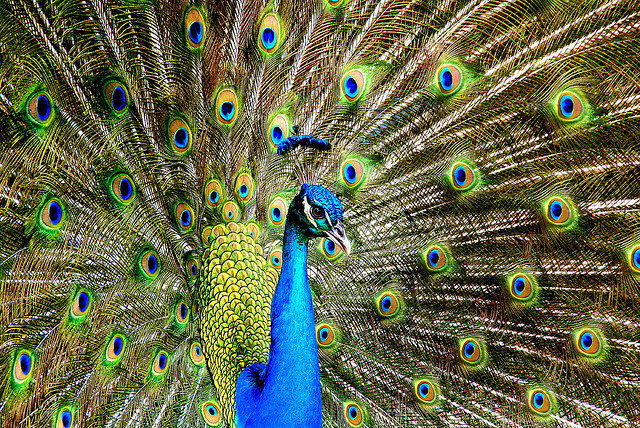
I’ve long spoken of the idea that much social media has turned into “social peacocking” — showing yourself in a favorable light online, presenting only the happy moments, a “highlights reel” of your life, so to speak, and how this leads to FOMO in others. Look at me: here I am doing cool things, in interesting places, with beautiful people. This has always given me some pause. When I look at Flickr and Findery, two social media companies I’ve built, they are not, I hope, venues for presenting the air-brushed version of one’s life. So many of the new social networks seem to encourage it. They seem pretty, but shallow.

It occurred to me that the real problem was not the showing off. The eminence grise that was Carl Jung showed us what can happen to those who stay on the sunny side, and only on the sunny side of life. Jung posited the idea of The Shadow, the dark side of one’s character. The Shadow is not only what is evil, but what is petty, selfish, childish, annoying, and usually unconscious. The more a person acknowledges his shadow, and brings it into consciousness, the healthier and more whole the person will be. But if driven underground and sent into hiding, The Shadow will take on a life of its own, like Dr. Jekyll and Mr. Hyde.

Ursula LeGuin wrote a magnificent essay, “The Child and the Shadow” (which I collected quotes from last year), in which she discusses the fairy tale “The Shadow” by Hans Christian Anderson. In the story a man allows his shadow to leave him, and the shadow goes on to live its own life, without the positive side of its character. Eventually the Shadow has grown strong, and the man has grown weak, and the Shadow come back and murders the man. LeGuin writes:

If the ego “is weak, or if it’s offered nothing better, what it does is identify with the “collective consciousness.” That is Jung’s term for a kind of lowest common denominator of all the little egos added together, the mass mind, which consists of such things as cults, crees, fads, fashions, status-seeking, conventions, received beliefs, advertising, pop cult, all the isms, all the ideologies, all the hollow forms of communication and “togetherness” that lack real communion or real sharing. The ego, accepting these empty forms, becomes a member of the “lonely crowd”. To avoid this, to attain real community, it must turn inward, away from the crowd, to the source: it must identify with its own deeper regions, the great unexplored regions of the Self. These regions of the psyche June calls the “collective unconscious,” and it is in them, where we all meet, that he sees the source of true community; of felt religion; of art, grace, spontaneity, and love.

Social peacocking is life on the internet without the shadow. It is an incomplete representation of a life, a half of a person, a fraction of the wholeness of a human being. It’s the lonely crowd, the network and society, and not the community, as Tonnies would have it. As Jyri Engestrom observed, it’s implied in Google’s mantra “Don’t Be Evil.” That’s the Yang without the Yin. We have to bring The Shadow back into our technology if we are to live there and find our humanity reflected back to us. In our strivings to be better, we must not forget to be whole.

Parenting, Communities and Crime

I came across a 1995 article by David T. Lykken attempting to make the case – both sensible and crazy – that society should require parents to be licensed before they can have children, an argument propounded by a libertarian, not a totalitarian, if I am understanding the last paragraph. John Stuart Mill is utilized for choice quotes, and a lot of interesting statistics about criminality are bandied about. Blame for the rise in the number of delinquents, punks and desperadoes is put on the shoulders of absent dads, single moms, and incompetent parents, as you would expect. Lykken is known for his work in twin studies, and lie detection.

1995 is the middle of a precipitous decline of crime in America, rather than an explosion of rape and murder, but such things are difficult to see as they are occurring.

crime rates falling 1990s

This graph is from Steven Levitt’s famous article, later developed into the bestseller “Freakonomics”, linking legalized abortion and the drop in crime. With Levitt, the bad-parents-create-bad-children argument is implied.

This is all interesting stuff. However, I found the most interesting part of the Lykken article to be a paragraph in the middle, about the role of community in shoring up poor parenting. It takes a village, after all:

Good parents, who are able to maintain the affection and respect of their children and whose offspring admire them and value their good opinion, can be reasonably certain that their values and ways of socialized behaving will be adopted by the next generation. The children of less effective, less competent parents will be more likely to adopt the customs and values of the peer group. [Small, close-knit] communities will achieve the same result. In urban or suburban communities, the offspring…will be somewhat more at risk…as the community grows in size and in mutual estrangement, the likelihood increases that there will be a few neglected, undisciplined or feral children in the peer group-faux-adult role models to whom a child not closely tied to home and parents may be drawn, and by whom that child will be influenced….we can reasonably conjecture that the relative importance of the peer group in shaping the values and behaviors of a given child is inversely proportional to the competence of that child’s parents.

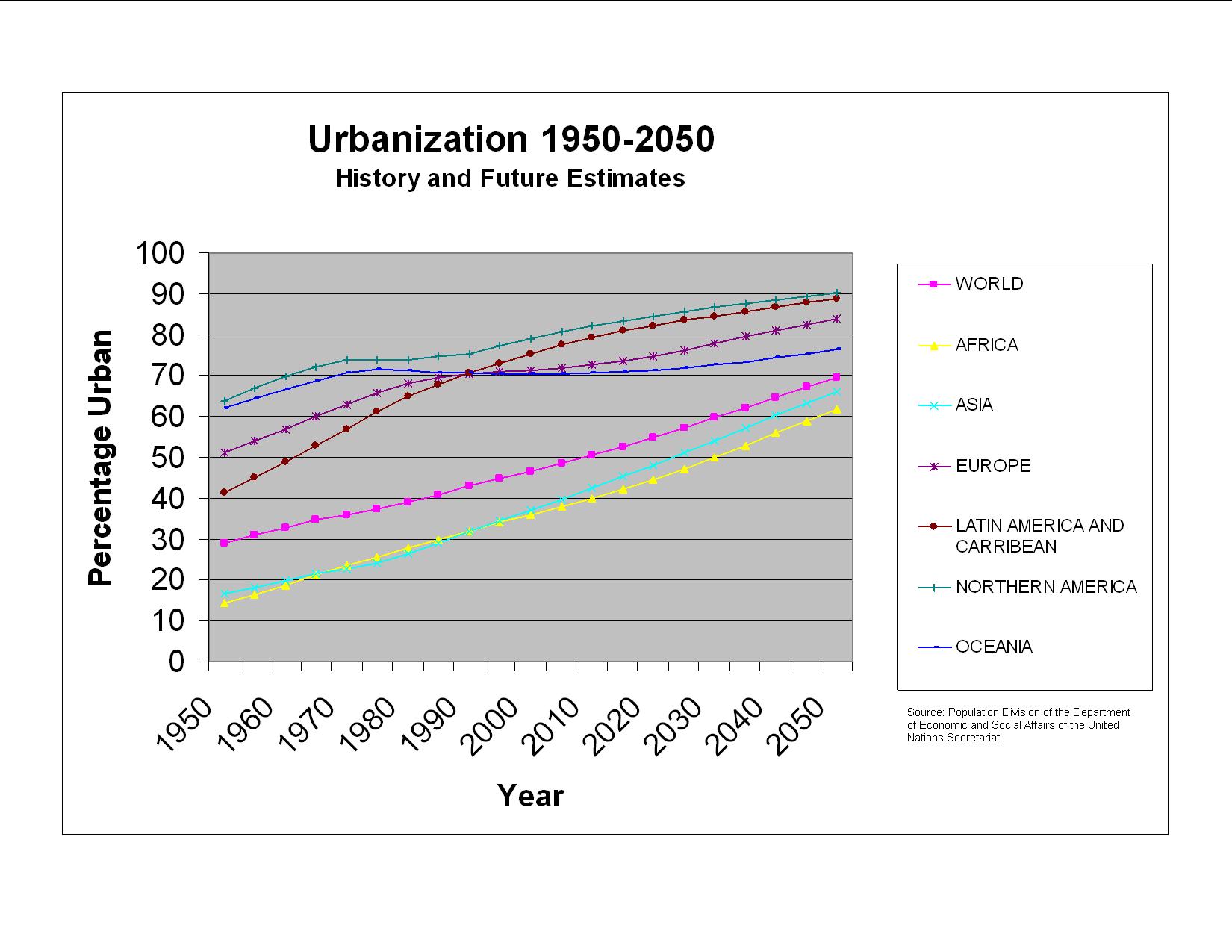
I am interested in this because I am wondering how a community can grow to be “small and close knit” in an urban setting, since, the future is urban:

urbanization by continent

And it is not only urban, but peer-oriented and media-oriented, rather than family- or community-oriented. I think that Lykken was right about a lot of things – we seem to have created a veritable garden of sociopathy – but wrong about the solution. Licensing parents implies an Orwellian state. Lykken suggests parents who parent without a license would be implanted with antifertility drugs, sent to institutions to learn parenting…No, no.

A less fraught, more effective and scalable way to help society raise healthy, sane children would be to figure out how to support the creation and maintenance of communities.

Online communities

The internet is full of strangers, generous strangers who want to help you for no reason at all. Strangers post poetry and discographies and advice and essays and photos and art and diatribes. None of them are known to you, in the old-fashioned sense. But they give the internet its life and meaning.

I first got online in the late 80s, when I was an eccentric teenager in suburban New Jersey, in a town mostly interested in sports, popularity and clothes. I was a reader, into Jorge Luis Borges, and I found, connected to and delighted in a group of Borges scholars from Aarhus, Denmark that I met online. It was early days, the days before COPA (now COPPA), chat rooms and a/s/l, when the level of discourse was high, and the number of scoundrels was low. The lonely “no one understands me” use case for online communities is one of the strongest ones. How many people, different from those around them, have finally found a home among strangers on the internet?

I learned most of what I knew about online communities on The Well, and it was a good place to learn. The group of people in Sausalito, Mill Valley and Bolinas who’d gotten the Whole Earth Catalog off the ground — a bunch of boomers, techies, hippies, intellectuals and nerds — established the “Whole Earth ‘Lectronic Link”, and showed us what online communities were. They taught us how to create a civilized space, to speak in our own voices, use our real names, fan the flames of friendliness, to boot and ban trolls. They showed us how to mediate flame wars, start and end conversations, tease out contributions from the shy and lurking, engage in healthy debate. The mantra of the place was “You Own Your Own Words”, a phrase coined by Stewart Brand, one of the Well’s founders, meaning you not only have the right to say your piece, but also that you have to take responsibility for the consequences of those words.

Maybe I just found all the great places to hang out online, but the communities I found were most often characterized by their incredible generosity. On Metafilter, a group of strangers worked together to rescue two women from villains who appeared to be sex traffickers. The nephew of a man with Downs Syndrome who was suffering from cancer posted that his uncle loved to receive mail, and received hundreds of letters from complete strangers. Amit Gupta announced that he had been diagnosed with leukemia and needed to find a matching bone marrow transplant, but it was difficult to find matches for Southeast Asians, who are underrepresented in donor databases. Countless conversations, tweets and blog posts conspired to help him — and subsequently other underrepresented groups — find a donor. The outbursts of care and kindness happen every day to my continual astonishment.

And then came the sunset of the Golden Age. The Dot Com era began, and things got serious. Online community became the hyped new thing that every new web site had to have. While motor oil, laundry detergent and pantyhose don’t seem like natural foci for gathering and sociality, attempts were made — repeatedly and laughably — to form communities around such products.  And forums and chat spaces, which I’d seen as a merry places for interesting people, became, often enough, shady places for iffy people. Because for every gay teenager living in a remote, conservative, homophobic town who finally connected with his people, a white supremacist found another. A cannibal found someone who was interested in being eaten. Trolling, hating and spamming became a surge, then a flood.

“Communities are defined by what they tolerate,” says Heather Champ, who worked with me at Flickr guiding and cultivating the community there. Flickr’s community was something we cultivated in a hands-on, very engaged way, greeting, welcoming and befriending the first 20,000 users. And, famously, in the Flickr community list of dos and don’ts, Heather wrote this beautiful, concise guideline :

Don’t be creepy.

You know the guy. Don’t be that guy.

Community management is an art, not a science. It requires an iron fist in a velvet glove, and Heather is a mandarin. She’ll endlessly fight for the disenfranchised to have their space, for artists to practice their art, for peaceful coexistence and tolerance, for people’s right to privacy — while ruthlessly squashing trolls and silencing the hate.

Now we are building a new community built around places, with a team that includes Heather. A lot of things have changed since the days of Flickr. Facebook has concentrated the sociality of the internet within its blue borders, like a Walmart siphoning off the mom-and-pop shops that formerly comprised the internet’s gathering places. Communication, in the age of mobile dominance, has become, of necessity, shorter and snack-sized. Gone are the long debates on The Well. Gone are the Olden Dayes of the Independent Web. But never gone is the miraculousness of connecting with people remote from our houses, but close to our hearts.

Each online community decides what it is going to be, and in the end, reflects the people that participate in it. The internet is made of people. Like Anne Frank, I believe that, despite all evidence to the contrary, people are good at heart. And always, on the internet, I am astounded by people’s insistence on being generous, compassionate and kind.

….

A version of this post appeared in Wired last year
Human rights begin in small places

Eleanor Roosevelt

“Where, after all, do universal human rights begin? In small places, close to home – so close and so small that they cannot be seen on any maps of the world. Yet they are the world of the individual person; the neighborhood he lives in; the school or college he attends; the factory, farm, or office where he works. Such are the places where every man, woman, and child seeks equal justice, equal opportunity, equal dignity without discrimination. Unless these rights have meaning there, they have little meaning anywhere. Without concerted citizen action to uphold them close to home, we shall look in vain for progress in the larger world.”

— Eleanor Roosevelt

Via Moyalynne

Quarrel not at all, or why one shouldn’t engage in online mudslinging

Photo via Flickr: https://www.flickr.com/photos/burge5000/22568539/

“Quarrel not at all. No man resolved to make the most of himself can spare time for personal contention. Still less can he afford to take all the consequences, including the vitiating of his temper and loss of self control. Yield larger things to which you can show no more than equal right; and yield lesser ones, though clearly your own. Better give your path to a dog than be bitten by him in contesting for the right. Even killing the dog would not cure the bite.”

— Abraham Lincoln

11 year old boys make a neighborhood

In the January 2012 issue of The Believer, there is an interview with cartographer Denis Wood, who created Everything Sings, a representation of Boylan Heights, NC, where he lives and raised his children. The maps are not typical maps, instead they depict, according to the article (I don’t have this book, though I’m ordering it!) “the light that fills the streets, the delivery routes of local newspapers, the face of pumpkins in front of homes at Halloween”, among others. Wood says:

I wanted to think about what a neighborhood is. What makes a neighborhood a neighborhood? What are the characteristics of neighborhoodness? There’s a theorist named Leonard Bowden who had the idea that neighborhoods are created by eleven-year-old preadolescent males. In their running through the neighborhood and connecting families together, crossing fences, going into homes that their parents would go into, and knowing people that their parents would never even acknowledge, they create the neighborhood. Not girls, because girls were not given the privilege of ranging like the boys were, and not older boys, because they were being directed by the school toward classmates at a distance.

Anonymity and Pseudonyms in Social Software

On Facebook, and now Google Plus, real names are required. Since its launch, there has been a fair amount of controversy surrounding the Google Plus policies, including this from a former Google employee who goes by the name of Skud, who had her account suspended. Today Jyri posted (on Google Plus) about Pseudonymous Accounts and why they should be permitted. He argues that people should “not be booted off the system for using a made up name” and quotes the diary of a gay teenage girl, Agnes, writing about her love interest, Elin, in Show Me Love:

This is not an edge case. Nor is it just about the two billion people who live under oppressive regimes. If you are a person who “thinks different”, think back. Were you ever the nail that sticks out, at some point in your life? Like in Amal, the home town of the two girls Agnes and Elin, the community preventing you from being all you can be the neighborhood school, church, friend group… often it’s your family.

Later in the afternoon Bradley Horowitz, from Google, posted about some changes to Google Plus addressing some concerns, allowing people to associate fictitious names with their accounts under “Other Names” (which can also be used for maiden names and the like), clarifying the rules during the sign-up process, and the implementation of a warning system prior to account deletions. He noted that he himself goes by the name “Elatable” on various places on the internet. And I think Google is being responsive and trying to do the right thing (That “Data Liberation” link gets me every time!)

The point I think is this: Pseudonyms are not in themselves harmful. Yes, they can be used for harm, as when people use them for anonymous, slanderous attacks, trolling, etc., but in the vast majority of cases there is no harm done. Importantly, they can serve to protect vulnerable groups. There’s even a comprehensive list of people harmed by Real Names policies. In the cases where pseudonyms are being abused, it is the harm that should be stopped, not the pseudonyms.

To my mind there are three categories of Pseudonymous behavior, and they should be treated differently:

AKA or “Also Known As” is a common use case. It’s like a stage name or a nom de plume. Say your Nom de Web is Kryptyk Physh. It’s not your “real name”, but you’ve staked your claim to it, it’s easier to register an original name in crowded namespaces, and your friends have come to identify you by it. These names are usually accompanied by a real name, like Bradley associating himself with “Elatable” or my friend Todd using his customary handle “Telstar Logistics“. The person is not trying to conceal his or her identity, just use a handle. Harm? None. It’s fairly easy to design systems to accommodate this, and this is the use case that Google Plus was addressing with their changes today.

Pseudonym A false name, or a name unassociated with a real identity, to preserve anonymity, for protection. The spectrum of danger ranges from people trying to avoid email-harvesting spammers, through gay teenagers risking the judgment of their peers and family, workers fearing they might lose their jobs, journalists in corrupt regimes or political dissidents who could risk prison or death. Sometimes their friends and allies know who they are if others don’t, in a kind of identity steganography. This is a strong case for allowing pseudonyms to exist online, and such white hat users can generally be identified by the content they post and their behavior online, which distinguishes them from

Trolls, a rubric I’m using to include Trolls, Harassers, Griefers, Spammers, Pimps, Exploiters, Slanderers, Criminals, Impersonators, Haters and so on — these are the abusers of anonymity, using false names as a convenient fig leaf to cover up anti-social behavior and to escape the consequences they’d face if they’d used their own names. Strong moderation is the solution to this problem. (And not to be forgotten: people harass others using their real names too.) On many systems there is a combination of real names and pseudonyms. The system can be designed to elevate in trust people using their real names, as Amazon does, and similarly can be designed to raise or lower the reputation of people using pseudonyms, by their behavior, using their posts, comments and contributions, rather than their identity. A general policy (that I use for my own sites) is to publish cogent, considered posts by anonymous contributors, but throw out posts that are angry, unproductive or concern trolling.

“Real identities” have real benefits to users — creating communities of trust, silencing trolls, people standing by their words. Nothing can destroy a happy social space faster than allowing the trolls to go unchecked. The use of real names online has gained momentum in recent years, I think as a consequence of the rise of social networking; in an earlier era this wasn’t the case. But most peoples’ pseudonymous online behavior falls into the first two categories — only the third needs policing. Pseudonyms, which provide so many benefits to the first two categories, should not be banned because of the third.

How real names benefit Facebook and Google is another story, for another post.

FOMO and Social Media

I’ve been watching Twitter and Ditto feeds of people at SxSW, and, from a distance, I get a distinct sense of the social anxiety and FOMO that’s going on there. “FOMO” stands for “Fear of Missing Out” and it’s what happens everywhere on a typical Saturday night, when you’re trying to decide if you should stay in, or muster the energy to go to the party. At SxSW I see people wondering if they’re at the wrong party—the party where they are is lame, feels uncool, has too much brand advertising or doesn’t have anyone there they’d want to hook up with—and so they move on to the next party where they have to wait in line too long, can’t get a beer, or don’t find their friends, and so move on to the next venue where…and so on.

FOMO is a great motivator of human behavior, and I think a crucial key to understanding social software, and why it works the way it does. Many people have studied the game mechanics that keep people collecting things (points, trophies, check-ins, mayorships, kudos). Others have studied how the neurochemistry that keeps us checking Facebook every five minutes is similar to the neurochemistry fueling addiction. Social media has made us even more aware of the things we are missing out on. You’re home alone, but watching your friends status updates tell of a great party happening somewhere. You are aware of more parties than ever before. And, like gym memberships, adding Bergman movies to your Netflix queue and piling up unread copies of the New Yorker, watching these feeds gives you a sense that you’re participating, not missing out, even when you are.

There is a company that sells radar equipment to the police as well as radar detectors to the public. Clorox is one of the world’s worst polluters of water, and also sells Brita filters to get the bad stuff out of the water again. Lawyers create mazes that you have to hire a lawyer to escape. Similarly social software both creates and cures FOMO. If you didn’t know that party was going on, you’d be home contentedly reading your latest New Yorker. But since you do, you hungrily watch each new tweet.

It’s an age-old problem, exacerbated by technology. To be always filled with craving and desire (also called defilement, affliction) is one of the Three Poisons of Buddhism, called kilesa, and it makes you a slave. There is true meaning in social media—real connections, real friendships, devotion, humor, sacrifice, joy, depth, love. And this is what we are looking for when we log on. Most of the world is profane, not sacred, in the Mircea Eliade sense. So it is. But within it is the Emmy award speech of Mister Rogers, a Japanese man being rescued at sea, Abraham Lincoln, moms who comfort sick children, the earnest love that dogs have for people…

FOMO can be fought. Stay alert! En garde!

(This work is licensed under a Creative Commons Attribution 3.0 Unported License.)