Jyri posted an article on Facebook, Where Inequality Took Root: “In the mid-70’s, we traded in our post-World War II social contract for a new one, where ‘greed is good.'” This amazing graph shows something big happened in the 1970s to prevent workers from sharing the gains of productivity in the workplace, but the question is, what?
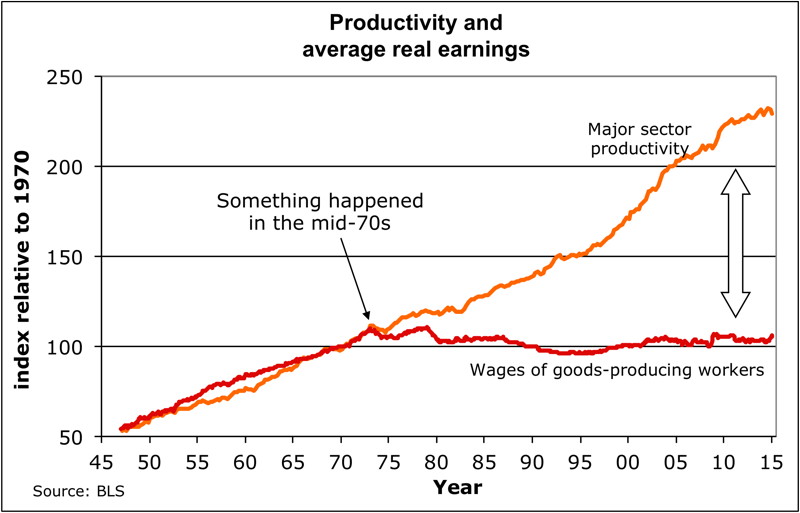
Jyri conjectures that personal computing may have had something to do with the changes.However, I think that was a small part of the changes going on in the United States at the time. The bigger changes were social.
There was a great deal of change during the 70s in terms of womens’ rights, gay rights, civil rights and also, significantly, immigration. For example, after Hart-Celler was passed, the ethnic makeup of the U.S. changed dramatically, viz, this data from Wikipedia:
“Prior to 1965, the demographics of immigration stood as mostly Europeans; 68 percent of legal immigrants in the 1950s came from Europe and Canada. However, in the years 1971–1991, immigrants from Hispanic and Latin American countries made 47.9 percent of immigrants (with Mexico accounting for 23.7 percent) and immigrants from Asia 35.2 percent. Not only did it change the ethnic makeup of immigration, but it also greatly increased the number of immigrants—immigration constituted 11 percent of the total U.S. population growth between 1960 and 1970, growing to 33 percent from 1970–80, and to 39 percent from 1980–90.”
My mother’s family immigrated from the Philippines to the United States when people from non-European countries were subjected to more stringent requirements than Europeans, and very few were allowed in. They believe they were admitted to the U.S., for example, because they had had a great deal of higher education, and graduate degrees from American universities.
The graph above can tell a thousand stories, and it is hard to point to any single factor. Personal computing may have changed the workplace dramatically, but I think it is likely that the social contract changed because the social construct changed. More women, more minorities, more foreign-born citizens were taking their places in American society and there was a growing sense of threat to entrenched power.






 Caterina.net