Online communities

The internet is full of strangers, generous strangers who want to help you for no reason at all. Strangers post poetry and discographies and advice and essays and photos and art and diatribes. None of them are known to you, in the old-fashioned sense. But they give the internet its life and meaning.

I first got online in the late 80s, when I was an eccentric teenager in suburban New Jersey, in a town mostly interested in sports, popularity and clothes. I was a reader, into Jorge Luis Borges, and I found, connected to and delighted in a group of Borges scholars from Aarhus, Denmark that I met online. It was early days, the days before COPA (now COPPA), chat rooms and a/s/l, when the level of discourse was high, and the number of scoundrels was low. The lonely “no one understands me” use case for online communities is one of the strongest ones. How many people, different from those around them, have finally found a home among strangers on the internet?

I learned most of what I knew about online communities on The Well, and it was a good place to learn. The group of people in Sausalito, Mill Valley and Bolinas who’d gotten the Whole Earth Catalog off the ground — a bunch of boomers, techies, hippies, intellectuals and nerds — established the “Whole Earth ‘Lectronic Link”, and showed us what online communities were. They taught us how to create a civilized space, to speak in our own voices, use our real names, fan the flames of friendliness, to boot and ban trolls. They showed us how to mediate flame wars, start and end conversations, tease out contributions from the shy and lurking, engage in healthy debate. The mantra of the place was “You Own Your Own Words”, a phrase coined by Stewart Brand, one of the Well’s founders, meaning you not only have the right to say your piece, but also that you have to take responsibility for the consequences of those words.

Maybe I just found all the great places to hang out online, but the communities I found were most often characterized by their incredible generosity. On Metafilter, a group of strangers worked together to rescue two women from villains who appeared to be sex traffickers. The nephew of a man with Downs Syndrome who was suffering from cancer posted that his uncle loved to receive mail, and received hundreds of letters from complete strangers. Amit Gupta announced that he had been diagnosed with leukemia and needed to find a matching bone marrow transplant, but it was difficult to find matches for Southeast Asians, who are underrepresented in donor databases. Countless conversations, tweets and blog posts conspired to help him — and subsequently other underrepresented groups — find a donor. The outbursts of care and kindness happen every day to my continual astonishment.

And then came the sunset of the Golden Age. The Dot Com era began, and things got serious. Online community became the hyped new thing that every new web site had to have. While motor oil, laundry detergent and pantyhose don’t seem like natural foci for gathering and sociality, attempts were made — repeatedly and laughably — to form communities around such products.  And forums and chat spaces, which I’d seen as a merry places for interesting people, became, often enough, shady places for iffy people. Because for every gay teenager living in a remote, conservative, homophobic town who finally connected with his people, a white supremacist found another. A cannibal found someone who was interested in being eaten. Trolling, hating and spamming became a surge, then a flood.

“Communities are defined by what they tolerate,” says Heather Champ, who worked with me at Flickr guiding and cultivating the community there. Flickr’s community was something we cultivated in a hands-on, very engaged way, greeting, welcoming and befriending the first 20,000 users. And, famously, in the Flickr community list of dos and don’ts, Heather wrote this beautiful, concise guideline :

Don’t be creepy.

You know the guy. Don’t be that guy.

Community management is an art, not a science. It requires an iron fist in a velvet glove, and Heather is a mandarin. She’ll endlessly fight for the disenfranchised to have their space, for artists to practice their art, for peaceful coexistence and tolerance, for people’s right to privacy — while ruthlessly squashing trolls and silencing the hate.

Now we are building a new community built around places, with a team that includes Heather. A lot of things have changed since the days of Flickr. Facebook has concentrated the sociality of the internet within its blue borders, like a Walmart siphoning off the mom-and-pop shops that formerly comprised the internet’s gathering places. Communication, in the age of mobile dominance, has become, of necessity, shorter and snack-sized. Gone are the long debates on The Well. Gone are the Olden Dayes of the Independent Web. But never gone is the miraculousness of connecting with people remote from our houses, but close to our hearts.

Each online community decides what it is going to be, and in the end, reflects the people that participate in it. The internet is made of people. Like Anne Frank, I believe that, despite all evidence to the contrary, people are good at heart. And always, on the internet, I am astounded by people’s insistence on being generous, compassionate and kind.

….

A version of this post appeared in Wired last year

Human rights begin in small places

Eleanor Roosevelt

“Where, after all, do universal human rights begin? In small places, close to home – so close and so small that they cannot be seen on any maps of the world. Yet they are the world of the individual person; the neighborhood he lives in; the school or college he attends; the factory, farm, or office where he works. Such are the places where every man, woman, and child seeks equal justice, equal opportunity, equal dignity without discrimination. Unless these rights have meaning there, they have little meaning anywhere. Without concerted citizen action to uphold them close to home, we shall look in vain for progress in the larger world.”

— Eleanor Roosevelt

Via Moyalynne

Pop-Up Magazine & Commencement

  • Pop-Up Magazine is an amazing “live” magazine that started here in San Francisco, and consists talks, performances, demos and slide shows in front of a live audience. It is a live event that only happens once, and is unrecorded, a rarity in these days of constant recording and archiving. It is almost impossible to get tickets — they go on sale at noon, and the entire Davis Symphony Hall — thousands of seats — is usually sold out by 12:05. Somehow we got tickets off the waiting list and were able to go on Monday night. The theme of the night was music, and framed by Beck’s collection of sheet music, performed by various artists — some were amazing, some were average. Stories about music, stories, songs. The ephemeral is so rare.
  • Today is Commencement ceremonies for The New School at Jacob Javits, where I am to receive an Honorary Doctorate. This will be the first graduation since Junior High School for Joi Ito, who is also receiving a degree. He wasn’t sure what the protocol was for robes and such, and we told him it was traditional to go naked beneath your robes. We’ll see what he shows up in.
  • While out here, I visited Donald at Findery East, and interviewed him for the blog about using Findery for his road trip. Williamsburg is so expensive these days!
  • We ate last night at Chez Sardine, where the music was too loud, and the service slow (though kind, and accommodating), but the food was excellent.

Scrapbook

  • Apartamento, a magazine out of Spain, but written in English, is one of my favorite magazines. The latest issue just arrived in the mail today and I am happily listening to YLE and leafing through it.
  • I was in NY last week for an Etsy board meeting — I love that company! — and a bunch of other meetings.
  • There is some amazing digital media at The New York Public Library, which I got to see too (after a lovely lunch at Szechuan Gourmet), and some beautiful maps. Hopefully some of the amazingness will be coming to Findery soon.
  • I’m sure there was some amazing art at the Frieze Art Fair, but I wasn’t able to find it. However, found some friends there, which was even better. And the boat to and from was lovely.
  • Mookie is an exceptional Westie that lives in the West Village. We walked him.
    Mookie

  • The wall at Le Philosophe is covered with French philosophers, and supposedly, if you are able to name all of them, they will pay for your meal. I was only able to identify Simone de Beauvoir, Sartre, Descartes and, I think, Foucault. And, I think, Luce Irigaray. The food was amazing, and I was happy to pay for it. Or, rather, to have it paid for on my behalf. Duck, hear? And the snails to start, which were as unlike any snails I’d had before as it was possible to be. Delicious.
  • Later, after a close call, we headed to Marie’s Crisis Cafe, a singalong piano bar specializing in show tunes. We managed some Summer Lovin, from Grease, and Let The Sun Shine In, from Aquarius, while managing our Tom Collinses.

Proust on Newspapers

What I fault newspapers for is that day after day they draw our attention to insignificant things whereas only three or four times in our lives do we read a book in which there is something really essential. Since we tear the band off the newspaper so feverishly every morning, they ought to change things and put into the paper, oh, I don’t know, perhaps…Pascal’s Pensees! …and then, in a gilt-edged volume that we open only once in ten years…we would read that the Queen if Greece has gone to Cannes or that the Princesses de Leon has given a costume ball. This way the proper proportions would be te established.

– Marcel Proust, In Search of Lost Time

Jack Gilbert and H.D.

Poetry! Just this week I’ve met two other poetry fans. It makes me happy to meet other poetry fans. Especially when they recommend poets I’m not familiar with. One of them recommended Jack Gilbert’s Collected Poems this week, and sent this lovely poem:

Failing and Flying

Everyone forgets that Icarus also flew.
It’s the same when love comes to an end,
or the marriage fails and people say
they knew it was a mistake, that everybody
said it would never work. That she was
old enough to know better. But anything
worth doing is worth doing badly.
Like being there by that summer ocean
on the other side of the island while
love was fading out of her, the stars
burning so extravagantly those nights that
anyone could tell you they would never last.
Every morning she was asleep in my bed
like a visitation, the gentleness in her
like antelope standing in the dawn mist.
Each afternoon I watched her coming back
through the hot stony field after swimming,
the sea light behind her and the huge sky
on the other side of that. Listened to her
while we ate lunch. How can they say
the marriage failed? Like the people who
came back from Provence (when it was Provence)
and said it was pretty but the food was greasy.
I believe Icarus was not failing as he fell,
but just coming to the end of his triumph.

Another new friend recommended H.D. to me. I’ve never read her poetry, but found Eurydice, which is a dark and powerful poem about hell. It concludes:

At least I have the flowers of myself,
and my thoughts, no god
can take that;
I have the fervour of myself for a presence
and my own spirit for light;

and my spirit with its loss
knows this;
though small against the black,
small against the formless rocks,
hell must break before I am lost;

before I am lost,
hell must open like a red rose
for the dead to pass.

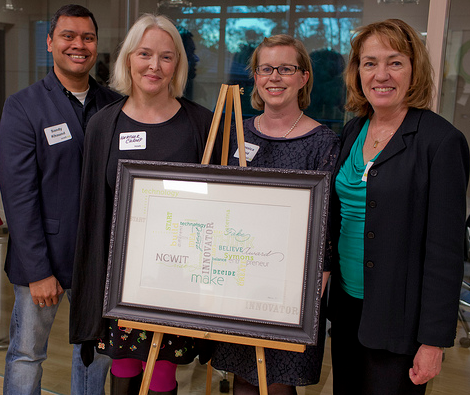
NCWIT Award

NCWIT award

A couple weeks ago, I was honored with an award from the NCWIT. the National Center for Women and Information Technology. Unfortunately, I had a bad flu and couldn’t accept the award in person. So my dear friend and colleague Heather Champ went down to accept it for me, and deliver my speech. This is that speech.

By clock and inch, by place and measure, by drive, dream and design, we’ve come here to California and to the keyboards of our computers, to make the future.

Our successes have been so great and so rapid that within 20 years we’ve gotten a third of the world’s population online, shrunk our computers to the size of our hands, and connected each to each. The magic, the generosity of spirit, the kindness, the art and the song that we’ve put into this technology and into this medium are in evidence all around us, every day.

But with all the glories, many defeats. We make our human mistakes. Connected to so many, we are intimate with fewer and fewer. We squander our days in amusements. Instead of truth, triviality. We are exhorted to sate the urges of the millions, their sloth, greed, pride or lust. We are told that this is what will make us a success. This is a deadly cynicism, which we must fight.

Because the internet is a medium, it doesn’t care whether it transmits love or hate. It is what we build and who we are that make it what it is. We can build things that diminish our humanity or build things that bring us to human flourishing.

There is great work to be done, and the women will lead us. So I say: Astonish us with your genius. Inspire us with your creation. Work with one another. Endure the tribulations. Dream, struggle, create, prevail. Be daring. Be brave. Be loving. Be compassionate. Be strong. Be brilliant. Be beautiful.

Thank you.