What happened in the 70s?

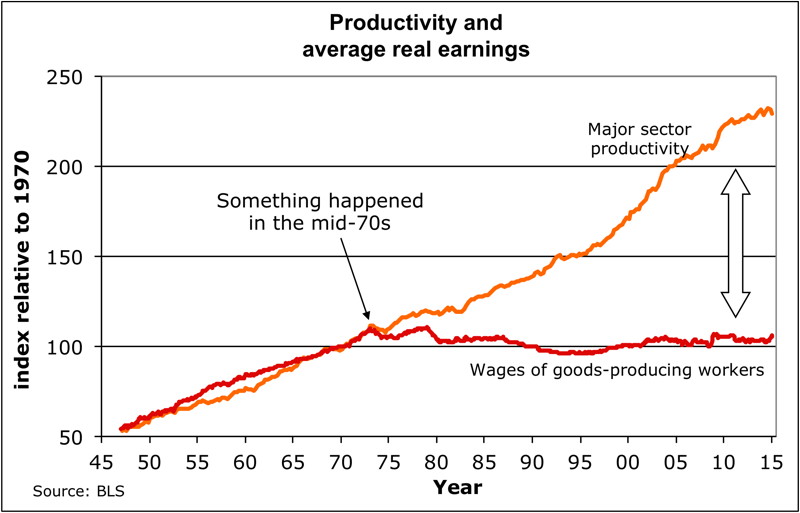
Jyri posted an article on Facebook, Where Inequality Took Root: “In the mid-70’s, we traded in our post-World War II social contract for a new one, where ‘greed is good.'”  This amazing graph shows something big happened in the 1970s to prevent workers from sharing the gains of productivity in the workplace, but the question is, what?

productivity-versus-wages

Jyri conjectures that personal computing may have had something to do with the changes.However, I think that was a small part of the changes going on in the United States at the time. The bigger changes were social.

There was a great deal of change during the 70s in terms of womens’ rights, gay rights, civil rights and also, significantly, immigration. For example, after Hart-Celler was passed, the ethnic makeup of the U.S. changed dramatically, viz, this data from Wikipedia:

“Prior to 1965, the demographics of immigration stood as mostly Europeans; 68 percent of legal immigrants in the 1950s came from Europe and Canada. However, in the years 1971–1991, immigrants from Hispanic and Latin American countries made 47.9 percent of immigrants (with Mexico accounting for 23.7 percent) and immigrants from Asia 35.2 percent. Not only did it change the ethnic makeup of immigration, but it also greatly increased the number of immigrants—immigration constituted 11 percent of the total U.S. population growth between 1960 and 1970, growing to 33 percent from 1970–80, and to 39 percent from 1980–90.”

My mother’s family immigrated from the Philippines to the United States when people from non-European countries were subjected to more stringent requirements than Europeans, and very few were allowed in. They believe they were admitted to the U.S., for example, because they had had a great deal of higher education, and graduate degrees from American universities.

The graph above can tell a thousand stories, and it is hard to point to any single factor. Personal computing may have changed the workplace dramatically, but I think it is likely that the social contract changed because the social construct changed. More women, more minorities, more foreign-born citizens were taking their places in American society and there was a growing sense of threat to entrenched power.

Women’s Eyebrow Fashions

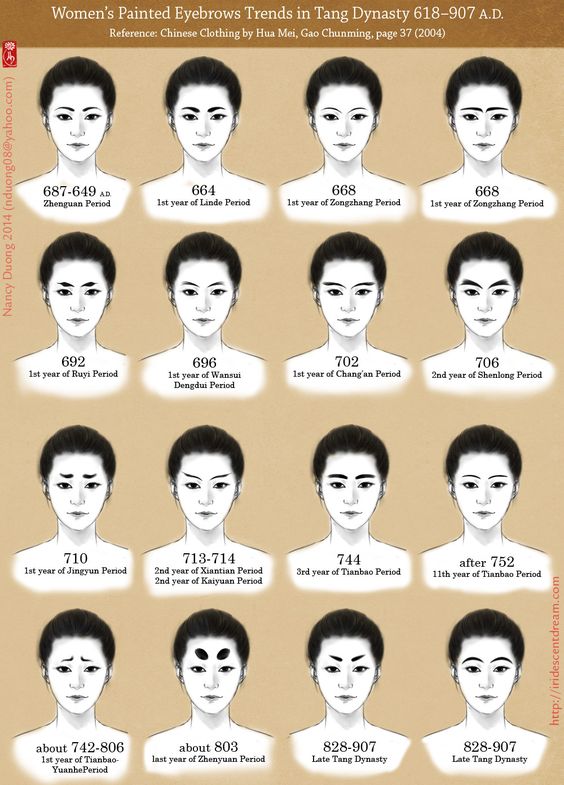
Women in the courts of the T’ang Dynasty (618-907) painted their eyebrows green; the standard of beauty was brows as delicately curved as the antennae of moths. Foreheads were powdered yellow with massicot, a lead oxide, for yellow was the color of vitality.

bf265bf2245fa0778d441d71f0ac0d9b.jpg

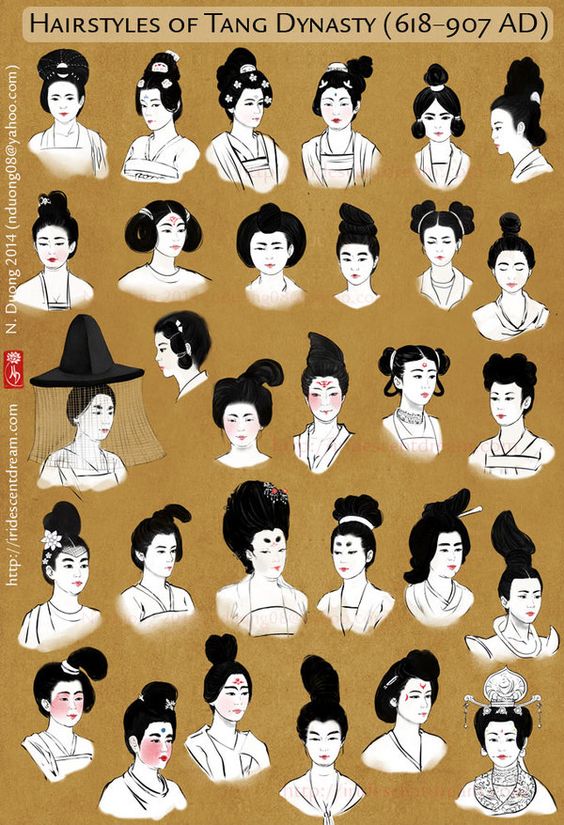
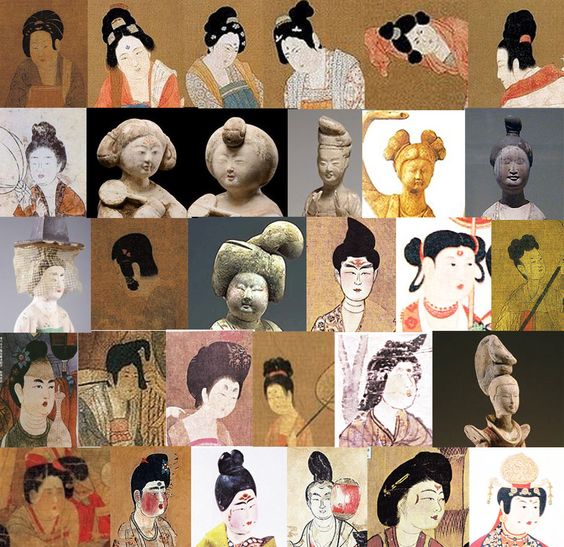
There are at least 24 hairstyles mentioned in the poetry, some a foot high, held together by lapis lazuli hairpins, clattering with pearls, with silk flowers and birds of gold perched on the top. As the empire was crumbling, the most popular styles had names such as “Deserting the Family” and “Uprooting the Grove”.

7b0fc5a25a23f4cf9ad6366ffaf075b5.jpg

Yang Kuei-fei, the emperor Hsan Tsung’s beautiful courtesan whose machinations set off a civil war, kept a tiny jade fish in her mouth.

–Eliot Weinberger, Oranges and Peanuts for Sale

f23f3e77d7f5a5d1ac013d3b5eea4cee.jpg

Anti-Psychiatry and Community Care

One thing that visitors from other countries–-we see a lot of Finns in our house––notice is that there are a lot of homeless people on our streets here in San Francisco, and that many of them are clearly mentally ill.

I was reading this article on Mute (whose tagline is the intriguing “WE GLADLY FEAST ON THOSE WHO WOULD SUBDUE US”) on the anti-psychiatry activities of an Italian psychiatrist in the 1960s, Franco Basaglia, and a book about him, The Man Who Closed the Asylums: Franco Basaglia and the Revolution in Mental Health Care.

All of this led me to look up the Community Mental Health Act of 1963, and then to this Timeline of Deinstitutionalization and its Consequences–all which made made ever clearer that mental health care in this country has gone from abuse to neglect, that more people in need of care are on the streets or in jails rather than in hospitals, all of which is a terrible crime against already suffering people.

Basaglia: ‘It seems important that people know that beyond “health” and “illness” there are human beings and there are contradictions that we cannot master individually.’

Don’t Feed the Trolls

In 1996 some friends and I published Wench, the feminist zine–what we called it in those days–which attracted some trolls (surprise!) Things haven’t changed that much, except that the leaders of our social media platforms aren’t doing much to moderate or manage their communities. As a reminder for some of my friends who just starting their careers as online feminists, a short guide:

  1. Don’t “feed the trolls” by responding or using your social capital to amplify them
  2. Block and ignore them
  3. Amplify people who should be heard
  4. Publish a text that refutes the trolls arguments without mentioning them
  5. You don’t need to participate in every conversation

Remember the Story of Guillermo Rodriguez

18375364-mmmain

On Aug. 19, 2015, shortly after midnight, the brothers Stephen and Scott Leader assaulted Guillermo Rodriguez. Rodriguez had been sleeping near a train station in Boston. The Leader brothers beat him with a metal pipe, breaking his nose and bruising his ribs, and called him a “wetback.” They urinated on him. “All these illegals need to be deported,” they are said to have declared during the attack. The brothers were fans of the candidate who would go on to win the Republican party’s presidential nomination. Told of the incident at the time, that candidate said: “People who are following me are very passionate. They love this country, and they want this country to be great again.”

– Teju Cole, A Time for Refusal

Notes from Wendell Berry's Home Economics

Wendell Berry is a great writer on community, the local, and how to organize a life. These  notes are from his collection of essays Home Economics. I also recommend What are people for?.

  • To call the unknown by its right name, “mystery”, is to suggest that we had better respect the possibility of a larger, unseen pattern that can be damaged or destroyed and, with it, the smaller patterns.This respecting of mystery obviously has something or other to do with religion, and we moderns have defended ourselves against it by turning it over to religion specialists, who take advantage of out indifference by claiming to know a lot about it.

    What impresses me about it, however, is the insistent practicality implicit in it. If we are up against mystery, then we dare act only on the most modest assumptions. The modern scientific program has held that we must act on the basis of knowledge, which, because its effects are so manifestly large, we have assumed to be ample. But if we are up against mystery, then knowledge is relatively small, and the ancient program is the right one: Act on the basis of ignorance. Acting on the basis of ignorance, paradoxically, requires one to know things, remember things — for instance, that failure is possible, that error is possible, that second chances are desirable (so don’t risk everything on the first chance), and so on. (p. 4-5)

  • Both the Greeks and the Hebrews told us to watch out for humans who assume that they make all the patterns. (p. 5)
  • Ignorance of where to stop is a modern epidemic; it is the basis of “industrial progress” and “economic growth”. The most obvious practical result of this ignorance is a critical disproportion of scale between the scale of human enterprises and their sources in nature. (p. 15-16)
  • The proper scale confers freedom and simplicity…and doubtless leads to long life and health. I think that it also confers joy. (p. 16)
  • No good thing is destroyed by goodness; good things are destroyed by wickedness. We may identify that insight as Biblical, but it is taken for granted by both the Greek and the Biblical lineages of our culture, from Homer to Moses to William Blake. Since the start of the industrial revolution, there have been voices urging that this inheritance [nature] may be safely replaced by intelligence, information, energy and money. No idea, I believe, could be more dangerous. (p. 20)
  • Everywhere, every day, local life is being discomforted, disrupted, endangered, or destroyed by powerful people who live, or who are privileged to think that they live, beyond the bad effects of their bad work. (p. 50)

Tyranny comes from democracy

tarot-tower

I read Chris Hedges’ book The Empire of Illusion: The End of Literacy and the Triumph of Spectacle, many years ago, and I was impressed by his strong statements and his searing condemnation of the educated class to which we belong, and how we lost the people by the cynically serving them spectacle, and how that spectacle would eventually become indistinguishable, to them, from reality.

In his trademark manner he articulated and clarified many things that had been vague, unformed ideas I’d entertained, writing of a future characterized by a widening gulf between the literate and the illiterate, complexity no longer understandable by the masses. His writing was hyperbolic, dire, doomsday. It seemed like an apocalyptic screed and much too dark. No more. His prognostications have been realized, the day he warned of has arrived.

Chris Hedges writes again, with many more now hopefully listening, that neoliberal kowtowing to corporate masters destroyed the underclass and opened the doors for fascism. He writes in an August 2016 article:

College-educated elites, on behalf of corporations, carried out the savage neoliberal assault on the working poor. Now they are being made to pay. Their duplicity—embodied in politicians such as Bill and Hillary Clinton and Barack Obama—succeeded for decades.

On behalf of corporations indeed. He excoriates the press too, in this interview with my former boss David Talbot, dismissing most journalists as stenographers for the powerful.

There are tens of millions of Americans, especially lower-class whites, rightfully enraged at what has been done to them, their families and their communities. They have risen up to reject the neoliberal policies and political correctness imposed on them by college-educated elites from both political parties: Lower-class whites are embracing an American fascism.

These Americans want a kind of freedom—a freedom to hate. They want the freedom to use words like “nigger,” “kike,” “spic,” “chink,” “raghead” and “fag.” They want the freedom to idealize violence and the gun culture. They want the freedom to have enemies, to physically assault Muslims, undocumented workers, African-Americans, homosexuals and anyone who dares criticize their cryptofascism. They want the freedom to celebrate historical movements and figures that the college-educated elites condemn, including the Ku Klux Klan and the Confederacy. They want the freedom to ridicule and dismiss intellectuals, ideas, science and culture. They want the freedom to silence those who have been telling them how to behave. And they want the freedom to revel in hypermasculinity, racism, sexism and white patriarchy. These are the core sentiments of fascism. These sentiments are engendered by the collapse of the liberal state.

The freedom to hate has arrived and we can see it in the streets, in stores, in classrooms today, unleashed by the election of Trump.  All over the internet you can find innumerable examples of rising fascism such as this, which happened yesterday in Queens:

cw5u9roxgaaqlm0

Hedges quotes Richard Rorty, an old favorite of mine, whom I encountered because of his chapter “The Barber of Kasbeam”about cruelty in the work of Vladimir Nabokov in Contingency, Irony and Solidarity particularly “the potential of cruelty inherent in the quest for autonomy”. Rorty writes in his 1998 book Achieving Our Country a prediction of our current state of affairs:

One thing that is very likely to happen is that the gains made in the past forty years by black and brown Americans, and by homosexuals, will be wiped out. Jocular contempt for women will come back into fashion. All the sadism which the academic Left has tried to make unacceptable to its students will come flooding back. All the resentment which badly educated Americans feel about having their manners dictated to them by college graduates will find an outlet.

But we can go even farther back than 1998 for this prediction.  Plato, in his Republic, warns that democracy is the very birthplace of tyranny. “Too much freedom seems to change into nothing but too much slavery, for both private man and city.” The Third Reich rose out of an era of great liberality and decadence, particularly in the cities, among the elite, a society of great freedom for women, gays, and Jews. At the time there was what people were calling a “überfremdung”–an “overpowering”–a great influx of foreigners into Germany.

There is a section, if you can bear to read it, on page 789 of your Bollingen edition of Plato, and continuing onto page 790 that describes a former oligarch, become a democrat, now shameless and resplendent in his freedom, sharing “equality” all around. See if you don’t recognize us in it:

“And does he not,” said, I, “also live out his life in this fashion, day by day indulging the appetite of the day, now winebibbing and abandoning himself to the lascivious pleasing of the flute and again drinking only water and dieting, and at one time exercising his body, and sometimes idling and neglecting all things, and at another time seeming to occupy himself with philosophy. And frequently he goes in for politics and bounces up and says and does whatever enters his head. And if military men excite his emulation, thither he rushes, and in his existence, but he calls this life of his the life of pleasure and freedom and happiness an cleaves to it to the end.”

“That is a perfect description,” he said, “of a devotee of equality.”

It is not reminiscent of the now classic description of the liberal elite as “tax-hiking, government-expanding, latte-drinking, sushi-eating, Volvo-driving, New York Times-reading, body-piercing, Hollywood-loving”? And, too, this “devotee of equality” is not unlike Hedges’ description of liberals lavish in their inclusion, but excluding one group in particular:

These elites, many from East Coast Ivy League schools, spoke the language of values—civility, inclusivity, a condemnation of overt racism and bigotry, a concern for the middle class—while thrusting a knife into the back of the underclass for their corporate masters. This game has ended.

This game has ended indeed, and not how we thought it would. We’re paying attention now. These have been bad days, and after my sorrow and shock, I begin working on a plan.

I seek relief in poetry, Plato and the care and feeding of children and small dogs.
Drunk people respect authority

Really interesting research by Laura Van Berkel shows that people who are drunk, tired, or suffering other types of cognitive impairment such as distraction or stress are more likely to be vulnerable to “those in charge” and when asked, affirm that “control or dominance over people or resources” is  a “guiding principle in your life.”  Equality is something a calm, leisurely person is more likely to support. We revert to hierarchy under cognitive stress.

According to a 2009 review, conservatives tend to support hierarchy andauthority more than liberals do. Van Berkel, working with Chris Crandall and other colleagues, found that, in terms of how the hundred and seven subjects interviewed outside the bar thought about hierarchy, drunk people gave more conservative responses while sober people gave more liberal ones. Over the next few years, she and her team ran five more experiments, exploring the relationship between mental effort and support for hierarchy. In each case, they found that cognitive impairments, such as being stressed or distracted, made people more likely to favor hierarchy. Even encouraging “low-effort thought”—by forcing respondents to think quickly, say—made people more respectful of those in charge.

There may be some sub-category of people for whom being drunk arouses their own need to dominate. We’ve all seen belligerent, brawling drunks domineering drunks and aggressive drunks. And people who are stressed at work are also more likely to do what the boss says. Equality, the article notes, may be a state of mind.


Further Reading

Also mentioned in the New Yorker article:
 Hierarchy in the Forest: The Evolution of Egalitarian Behavior by Christopher Boehm. A 1999 book in which Boehm, an anthropologist theorizes egalitarianism is in effect a hierarchy in which the weak combine forces to dominate the strong. Domination does not disappear, it just gets distributed.